Thursday, 11 August 2016

Object #45 - Juice-cup - Starred Up (2014)

Dir. David Mackenzie 


Mackenzie's Starred Up is so much more than your average prison movie. The father-son relationship of Eric (Jack O'Connell), the son, and Neville (Ben Mendelsohn), the father, is the core of the film. Eric has 'starred up', meaning he's just upgraded, as it were, from juvenile prison to regular prison due to his age. He's imprisoned in the same block as his father, who shares a cell with a male lover, Ashley (David Avery). First things first, we can clearly see that the family isn't exactly what you'd call 'wholesome' by the standards of society. Neville has likely killed to end up in prison, although the crimes of many of the prisoners are never elaborated on, and his son has led a life of crime from a young age, following in his father's footsteps.


But, the two are estranged. To sum it up, Eric has 'daddy issues', as Neville has never been there to raise him, mainly because he's been in prison; and we later learn that when Neville was living with Eric, he was never affectionate - not very surprising. Neville is the key to understanding how Eric has become what he's become, however Eric shows signs of independence that he's fostered away from Neville. The very first scene of the film shows Eric MacGyvering simple objects to create a usable weapon on the guards. Eric joins Oliver's (Rupert Friend) group counsel sessions, and we see how his shell is softened, and he opens up to his fellow prisoners - see this clip, where out of session he shares a cup of tea with his counsel-members and they talk about their mothers; Eric replies "I haven't got one" - simple, but it gets the point across, and we see that it's been him either flying solo resenting his dad, or with his dad, resenting him even more.

An argument in the middle of the film takes place between the two as Neville finds Eric's 'fraternizing' with his fellow counsel members out of session to be wrong, and he thinks that as a son he should listen to his father. This is the prime sense of discordance between the two - Neville is incapable of seeing Eric as a human being independent of being his son - who he must protect, give advice to, but never empathise with. Eric craves that empathy.


ENTER: Our Object. In the scene (unfortunately it's not available on line), Eric goes to Neville's cell, finding that he isn't in. Ashley welcomes him in. Pause here. There is a little bit of tension as viewers here, not bad tension necessarily, but it's odd to us to see Eric, Neville's son, interacting with his father's male lover. Men sleeping with other men, and being dependent and affectionate with other men (as Ashley is with Neville) unfortunately still doesn't sit right with the societal standard of male masculinity, and that is a standard that is massively amplified in a prison scenario. By how affectionate and open we see Ashley being, it's likely that he is gay, and is comfortable with being affectionate (later in the scene he rubs Neville's knee to try and get him to empathise with Eric); however we know Neville is/was straight, as Eric is his son, so it's likely that he's 'situationally gay' - a common finding in prisons where due to a lack of women, regularly straight men become affectionate with each other, sometimes also being a dominance thing although it doesn't seem to be the case here.  

We then cut to when Neville returns to the cell, and we see that Eric has a cardboard juice-cup which he's been drinking from, as he's been talking with Ashley. Eric tells his dad that he's here to solve their issues and talk, which Ashley comments "Is a good thing". Ashley here is acting as a supportive partner to Neville, but also Eric, like a mother in a classic straight-family scenario. So in the scene that is his role, however as discussed, there is this tension of masculinity and unsaid judgement between father and son on this affection.   

Eric: "You just order me about and tell me to do stuff. You don't give a fuck about how I feel. [Neville nods him on during a pause] Well, that's it." 
 Neville can't grasp this. He thinks that someone must be threatening Eric, making him do something, as in his mind, why else would he come to his father? He becomes aggressive, ready to defend his son. Here is where Ashley puts his hand on Neville's knee, telling him that Eric is trying to tell him something. Neville, gently pushes his hand off, gestures with a point - clearly telling Ashley that he shouldn't do that in front of Eric. Neville is tied to the masculine father archetype - unfeeling, unaffectionate in front of his son, and didactic. Eric sighs, seeing that his attempt to tackle the main issue is failing, and leaves.


So why is that juice cup important? I think it's a genius bit of prop use, as later in the film, Eric meets with Dennis (Peter Ferdinando), the boss of this block, someone even higher up than his father. In their meeting what does Dennis give Eric? A: a cigarette. A cigarette vs. a cardboard juice-cup with a plastic straw, the kind of thing that you give a child. The respect that Eric deserves is conveyed in the object given to him (remember it's prison so objects carry more meaning and value here as gifts) by Dennis. So in a scene where the barriers between father and son are reinforced, we get the infantilizing juice-cup. I honestly don't have much more to say than I think it's a very subtle but very effective way of visual distinction between the regressive father-son relationship, and the more business-like nature of criminal relationships, still very much tied to that notion of masculinity. Also it gave me a chance to discuss this fantastic, fantastic film. Seek it out if you haven't already, if only for Mendelsohn's award-deserving performance, which naturally wouldn't be half as good without O'Connell's Eric.  

Wednesday, 22 June 2016

Object #44 - Marble Statues - Pride and Prejudice (2005)

Dir. Joe Wright


Pride and Prejudice, as a story, is about women in a particular time and place. One woman in particular, Elizabeth Bennet (Keira Knightley). Better men and women than I have analysed Jane Austen's original text, and better film critics have done the same to the myriad of adaptions that have taken place down the years. Probably the most highly acclaimed is the BBC's 1995 adaption starring Jennifer Ehle and Colin Firth, which is fantastic, but unfortunately overshadows this oft-forgotten classic. 

Like any classic, nearly every scene strikes you with a feeling of 'This is just fantastic!', and again, like most classics, this happens due to many factors coalescing into a truly satisfying whole. The scene which struck me the most, and is a great example of the particular merits of this film, comes approximately half-way through the film, where Elizabeth visits Darcy's (Matthew Macfadyen) estate. Despite their strong attraction to each other, Elizabeth rejected Darcy's earlier proposal to marry, finding him arrogant and presumptuous. It's strong stuff, as most women in this time would kill for the chance to be married to this upper-class, rich, attractive man (Side-note: The recent BBC War & Peace adaption similarly goes into this territory, and is well worth a watch). Elizabeth then, has a strong conviction to marrying on her terms, and is opposed to being treated as a piece of property, or marrying someone who she does not wholly love, as displayed earlier with Mr. Collins (Tom Hollander).    


In Darcy's estate, she finds a gallery of marble statues. It is here that she is wooed by Darcy, and he isn't even present. Gentle piano music accompanies the scene as Elizabeth appreciates the artistry of not only the building itself, but the beautifully-sculpted marble statues. This is a collection assembled by Darcy, and so by appreciating his tastes, she can appreciate him, and she does appreciate his choices. As she looks at these statues, we wonder if she shares the same thoughts as Darcy, and of course this is true, as she is clearly re-apprising Darcy, as how could a man so arrogant , find this art as beautiful as she does? 

It goes beyond this however, as one statue in particular catches her attention, Monti's Veiled Vestal Virgin. The Vestal Virgins were sacred women who guarded and kept burning the sacred flames of Rome, dedicating their lives and womanhood to this task, forsaking any relationships. A man such as Darcy, who can appreciate the subtext of this statue, as well as its aesthetic beauty, is clearly a man who understands the plight of women, their role in relation to men, and more than anything, their beauty beyond their sexual nature. They are therefore, not objects, not something 'to-be-married', but people in their own right. These are issues that Elizabeth has rebelled against and is clearly conflicted over - will she be a virgin all her life by passing over these men who wish to be her husband? Is her reasoning for doing this strong enough?


Yet here is a man who understands this, wants to marry her, and, as she muses over a bust of Darcy himself, is attractive. She responds to the housekeepers questions: Knowing him "only a little", and stating that yes, he is "handsome". But he is attractive not only in physical beauty, but in soul, and her knowing him a little, is clearly something she now wishes to remedy. She has fallen in love with him, and we know this only be her appreciation of these statues, and her short answers to the housekeepers' questions. Knightley deserves all the plaudits she gets for this scene alone, as it is all her, with some help from a little music, minimal dialogue, and of course, some beautifully sculpted statues. 


Monday, 1 February 2016

Object #43 - Snowdrops - The Revenant (2015)

Dir. Alejandro G. Inarritu


This is going to be another human moment post. The moment takes place at around the midpoint of The Revenant, where our protagonist, Hugh Glass (Leonardo DiCaprio) is at a low, a place which he inhabits for the majority of the film. To keep it as spoiler free as possible, he meets a Native American, Hikuc (Arthur Redcloud) who is at first cautious of Glass, but who shares some bison meat with him regardless, and after hearing Glass' motivations, aids him in his injured state. The two ride together, this being the first companionship Glass has had in around 40 minutes of screentime. 

We get this beautiful scene where the two, who can actually understand each other, a change to most films dealing with Native Americans, nonetheless share a moment of bonding that doesn't require words. Hikuc sticks his tongue out, catching snowdrops on his tongue, chuckling as he does it. Glass mimics him, enjoying the moment. It's about the most joy he's had in the entire film. The two laugh. 


A snowstorm kicks up and Glass collapses, unable to go on due to his injuries. In another moment of supreme kindness in the harsh Frontier, Hikuc cuts down some firewood, lights a small campfire, and creates a wooden shelter for Glass. This is the second of three moments in the film where Glass is enwrapped, in comparative safety, before re-emerging, his injuries healing more and more each time. The first is his 'burial', where he is one with the land. This is the second, where objects of the land, trees, shelter him. The third, the inside of a dead horse, is him within a dead living creature. Each time he emerges re-born, and the final is a clear allegory of re-birth; a new man, with a singular purpose, born from the dead.

Glass awakes this second time with Hikuc gone. He has left behind some provisions, and has done well by Glass in creating the shelter. An unspoken bond ties the two together, in an act of human kindness. Spoilers here, apologies. Glass later comes across Hikuc's corpse, hanging from a tree. He has a sign in French around his neck, and even to a non-French speaker, the meaning is clear - he was murdered due to his being a 'savage'. It's all the more powerful because we know that Hikuc was one of the most human of humans Glass had encountered in the film. 


It's all the more depressing as we realize that he was killed by the same group of Frenchmen who we saw earlier in the film, led by Toussaint Charbonneau (Fabrise Adde). The Frenchman, despite some coercing, honoured their agreement with the chieftain Elk Dog (Duane Howard), and respected his quest to save his daughter Powaqa (Melaw Nakeehk'o). This, it turns out, was a bold-faced lie. They were the kidnappers of Powaqa, and we see Toussaint rape Powaqa, who is freed by Glass. It adds a sense of moral corruption and grey area in a film that has, for the most part, been fairly morally clear. 

The entire sequence has a lot going on, but what I want to focus on is the fact that Hikuc as a character fulfills his goal here, showing that even the most (at least to our eyes) morally good of people and groups can act in what appears to be counter-intuitive ways. The rape of Powaqa is a little on the nose, but it hammers home the message that the Native Americans were being ruined by the invading white men, of all creeds and colours. We see that in far subtler ways with Hikuc, and indeed the backstory of Glass and his motivations are very much tied to the ruining of the Native Americans. Their portrayal as inhuman attackers in the introductory scene, and for the most part of the film, is clearly more a way of conveying how the attacked perceive them, rather than being a condemnation, thank Inarritu!

As the film goes on the morals become hazier, and the Native Americans are present in the cumulative moment of revenge. I love The Revenant's discussion and exploration of the Native Americans, despite them not being the focus of the film itself. They are however integral to the Frontier, and it is fitting that their mythology and presence is felt at key moment of the film - most prominently the beginning, the middle, and end. 

Tuesday, 27 October 2015

Object #42 - Doors - Evil Dead (2013)

Dir. Fede Alvarez 


It's Halloween season! Time to break out the horror films. I can't say I'm massively well-versed in the genre, but I do enjoy them if they're done well. I'm missing a lot of the classics like Friday the 13th and the original Dawn of the Dead, but I've caught up lately on the Nightmare on Elm Street films, and I've seen quite a few classics like The Exorcist and The Thing; and the even more vintage Universal monster flicks such as Creature from the Black Lagoon, The Mummy, and Dracula. Honestly, as long as there aren't a bunch of cheap jump-scares, I'll probably enjoy it.

The Evil Dead series has never been serious horror. The first film, released back in 1981, is a lovely bit of cheap-horror that has since solidified the 'teens-in-the-cabin-in-the-woods' mythology of horror, as satirized in, well, Cabin in the Woods. It's not scary-per-se, in fact, a lot of the makeup looks a bit goofy these days, but it's clearly structured like a straight horror film, with a little levity in the dialogue. The second quickly re-caps the plot of the first film before descending (or should that be ascending?) into the best wacky comedy-horror put to film. Army of Darkness is pretty much an action-comedy that just happens to continue from the second film. My point is, the Evil Dead franchise is less about frightening you, and more about having a fun time, it just so happens to involve demonic possession, a rape-tree, and a lot of blood.

The 2013 remake, as far as I'm concerned, is one of the best horror films of the last five years. Now now, don't get me wrong, it doesn't hold a candle to It Follows or The Babadook for actual fright/creep factor, but as we've established, Evil Dead has never been about that. But within the horror genre, it's so damn fun. It's gross, cringe-inducing, funny, and more than anything, visceral. You feel what the characters go though, with every single one taking a hell of a beating, and each one deserving any victory they get. It's remarkably well-shot, well-produced (the cabin is gorgeously constructed), and of course, has great CG/make-up work when everything gets a bit stabby. The only possible mark-down I can give it is a little bit of pacing issues, not the best sign for a 90 minute film, but it is such a bare-bones story in the first place that I cut it some slack. By all other criteria, Evil Dead (2013) is a fine film.


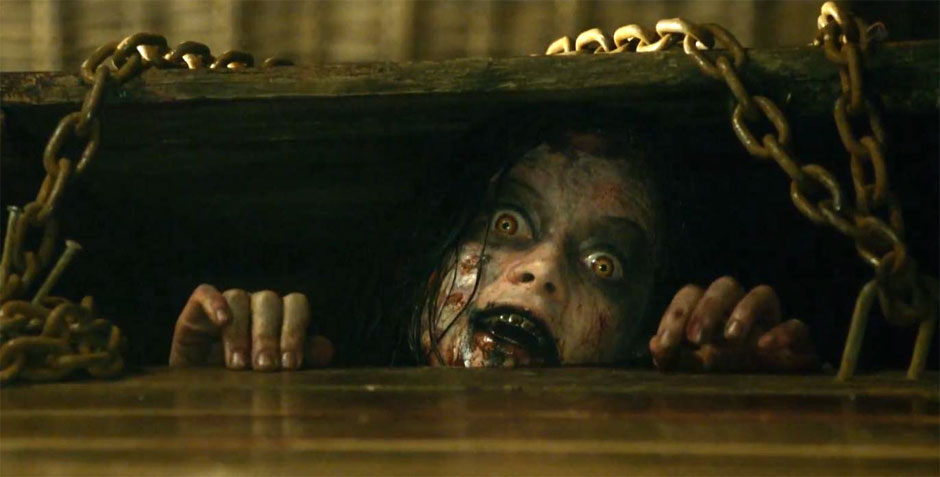
So - doors. The demonic entity awoken by Eric (Lou Taylor Pucci) primarily takes influence by possessing Mia (Jane Levy) and spreading from there. However, I noticed that the only other physical influence it has, beyond spreading biologically through vomit or blood, is by slamming doors shut. It's actually impressive how much it achieves by shutting a few doors. The obvious to note here is the trap-door leading to the Necronomicon book in the basement, which contains the words to awake the demon. This trap-door is pretty iconic for the shot in the first picture, also present in the original film. Mia is thrown into the basement, the trap door shutting her in. 

After Olivia (Jessica Lucas) is infected, becomes possessed, and begins to move towards Eric in the bathroom to kill him, what does the demon do? It shuts the door. It's making sure that no-one will interrupt the murder, and stopping Eric from getting away. Functionally it also remind us of the power it holds. Later, Natalie (Elizabeth Blackmore) sees the trap-door suddenly open, and hears Mia crying, luring her to enter the basement. The demon is clearly having fun with the slow-burn of killing these teenagers, as it has the power to open the trap-door at any time. It relinquishes Mia, having her give an honest performance of fear and confusion, leading Natalie into her domain.


The box-cutter scene happens, and yes, it's gross in all the best ways. After Natalie is rescued from the possessed Mia, David (Shiloh Fernandez) chains it shut. The demons toys with this as it pokes it's head up through the gap in the trap-door, taunting Natalie as she resits infection. Doors then, particularly the trap-door, are important set-ups for different power-struggles between the teens and the demon. 

Later into the film, as David returns to get the keys so that he and the now, demon-free Mia can leave, he is critically wounded by the dead Eric, who he forgot was still in the house and open to possession. What's important however, is that David is now the one who has the power, as he shuts the door, locking Mia out of the house, so that he can now shoot a gasoline can, killing himself, Eric, and burning the cabin. After this then, there is no upper-hand between demon and human. There are no more doors to toy with on either side. The Abomination admittedly is stronger than the regular undead, however Mia evens the score with a chainsaw, and eventually wins out.  

Actually, now I think about it, I could mention the car door of the Jeep. The classic horror-trope of reaching for the keys on the floor, sudden enemy in the window, attack on the the driver does happen here. So that's score-one for demon when it comes to doors. The car is tipped over, crushing Mia's hand and pinning it to the floor, under the door. She struggles, boy does she struggle, tearing her arm away from her hand, giving her the advantage of reaching the chainsaw; (Also, calling back to the original films in an original way, good-going Alvarez!), score-one (and match) to Mia for escaping the hold of the door and being able to end the demon. 

It's basic story-telling at the end of the day I suppose. What do doors do? They stop people from leaving rooms, they are an antagonist in the most basic sense, but when possessed by a demon, they're definitely an antagonist. Why demons don't just possess guns or knives instead of wooden doors I don't know! Actually, yes I do, because that wouldn't be fun, and if there's anything Evil Dead is, it's fun. 

Thursday, 15 October 2015

Object #41 - Comb - Three Colours: White (1994)

Dir. Krzysztof Kieslowski


Kieslowski's Three Colours trilogy is some of greatest drama I've seen put to film. With Tokyo Story in the last post, I seem to be gravitating towards human dramas lately! Unfortunately, I fall in with the general opinion that White is the least effective of the three films, with Blue and Red shifting in my estimation depending on my mood, Blue usually wins out though. All three films have a heavy focus on objects as symbols, as well as colour, naturally, and so it felt right to finally add one of them to the blog.

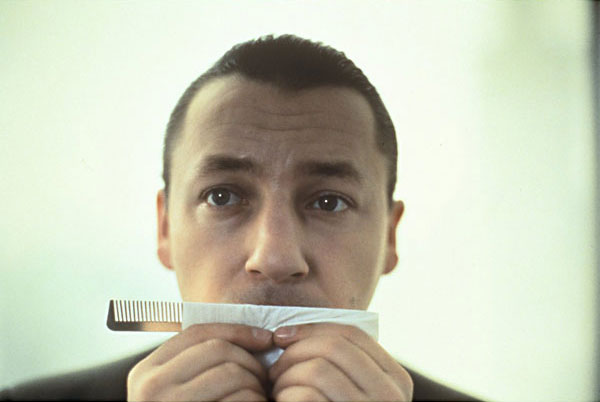
If you don't plan on watching White, then watch this video from the sublime Criterion Collection, which acts as a sort of visual guide to the film. It also includes a brief clip of the scene with the comb. Stranded in Paris, penniless, (well, he has a two franc coin, an important object in and of itself) abandoned by his wife (Julie Delpy), Polish-born Karol Karol (Zbigniew Zamachowski) has to sing through a comb to beg for any change the Parisian underground travelers will offer him. Luckily, a fellow Pole, Mikolaj (Janusz Gajos), offers him a plan to return to Poland. 


To be brief, and to quote, Jack Sparrow "complications arose, ensued, were overcome". Karol re-established himself in Poland, and turned to a life of crime. Now don't get the wrong idea from that sentence, it doesn't suddenly turn into a gangster film, but nonetheless, Karol grows through crime with his business partner Mikolaj. Their relationship is a complicated one, with suicide, murder, and soul-searching involved, but all you need to know is that they have a deep history, tracing all the way back to the underground in Paris. 

The moment the comb comes around and serves a greater purpose is around 2/3rds of the way into the film. Karol now uses the comb (it isn't clear if it's the same comb, but it is likely), as, just that,  a comb. He is suited, with slicked-back hair, a man of means. He has risen from that underground and now finds himself in a new high-rise building he's bought thanks to his business dealings. He turns to Mikolaj, pulls out the comb and a handkerchief, and hums the very same tune.  


This moment comes about an hour after the underground scene, after many plot and character developments, but this object, and the world of difference in the context in which it's used, brings us right back to the empty, hopeless world Karol began from. It is a symbol that with the right help, and a bit of luck, a man can make himself anything. 

The theme of the film is equality, as denoted by the colour white, based on the French flag. This taps into that, with every person being equal to make something of themselves, just as they are equal to have some beneficial luck. The equality theme extends to Karol's wish for revenge against his wife, with him wanting to leave her just as alone and hopeless as he was. Does he succeed? Go watch the film and find out!     

Compared to some of the other objects from the entire trilogy, the comb is relatively simple. I like it nonetheless and I'm likely at some point in time to return to the other two films in the trilogy. Honestly, I think the comb is only so simple in the context of the trilogy. Kieslowski is so very good at what he does that he has numerous objects in the same film that act as symbols, have resonance, and this is atop his masterful use of colour (he really does sell the concept of a colour theme for liberte, egalite, and fraternite). These are superb films in every right: cinematography, acting, score, every single aspect of the film is on-point, with a slight script and editing sag in White. As you can tell though, it's still a very subtle and nuanced film, and one that can stand equal with the other two films in the trilogy, which is of course, quite fitting.  

Tuesday, 13 October 2015

Object #40 - Hand fan - Tokyo Story (1953)

Dir. Yasujiro Ozu 


Ozu's Tokyo Story topped the 2012 Sight and Sound director's poll of the greatest films of all time, and came third in the combined critics and directors poll, behind Vertigo, and Citizen Kane. This is a phenomenally well-regarded film. It gladdens me immensely that a film that only moves the camera once can be so well-regarded by the great directors of the world. This a film that is still. No fancy moving one-shots, no fancy lighting effects, just a camera placed strategically well, and a scene played out by actors. The story is just as simple, two grandparents visit their children and grandchildren for a few days. That's the premise. The only narrative development is that the grandmother, Tomi (Chieko Higashiyama), falls critically ill and dies shortly after their return. 

I've spoken before about how one human moment can redeem a film for me. Tokyo Story, in under two hours, made me mourn the loss of this woman. I genuinely felt a profound sense of loss for the remainder of the film without her. How is this achieved? Human moments, human moments in abundance. I'm actually not going to go into them, because I'd essentially be reading you the script, it's that good. The relationships between the visiting family members will be immediately familiar to anyone who has visited/has been visited by extended family. The reality of the drama is spot-on, and is accurately acted even by the younger actors.


Anyway, I'm blabbing on. The reason I chose the hand fan, or rather fans, from this film is a bit of an obtuse way of discussing how Tomi's death resonates with the audience. Throughout the film, and I really do mean throughout, people use fans to keep themselves cool, naturally. In the beginning of the film, as we are introduced to Tomi and her husband, Shukichi (Chishu Ryu), with them chatting to each other in the gentle, calm way that life partners of a certain age do. No grand gestures of love, the dialogue itself fairly mundane, but it speaks wonders of the deep, deep love the two share. A neighbour walks by the window, and has a brief, neighbourly chat about their going away to visit family in Tokyo. It seems to be a nice routine, and is, again, immediately recognizable to all of us.


Jumping to the end of the film, Shukichi sits in the same room, alone, fanning himself. If you haven't seen the film, then I hope I'm conveying my message here with the structure of this post. For that neighbour, nothing has changed except that Tomi no longer sits with Shukichi. She does know of the death, and sympathizes with Shukichi, but she has no idea of the relationship development Tomi and Shukichi went through with their family in her final days. It's nothing drastic, but it tells us magnitudes about the characters and the family. The most monumental character moment actually occurs due to her death, with Shukichi giving Noriko (Setsuko Hara) Tomi's watch as a memento. He gives this to his daughter-in-law, widowed due to the death of his son, and despite no blood relation, he emphasizes that she was the one who treated the two of them the best during the visit. It's heartrendingly beautiful, and I nearly chose the watch as the object for this reason. I honestly think if I grew up in Japan, where family bonds are so strong, that this moment would be even more powerful. 

So why the fan? Because it's unchanging. People change, people die, people drift from their parents. The fan is a constant in the film despite all the developments that occur. True, there's one less fan in the ending, and true, Shukichi, in his own restrained way is clearly grief-stricken in his discussion with the neighbour: "If I knew things would come to this, I'd have been kinder to her. Living alone like this, the days will get very long". But despite all this change, he still needs to cool himself with a fan, as do others. The fan, to me at least, links the personal story of this family to the wider world of Japan, as well as to the world at large, across time. It's a cliche, but the more things change, the more they stay the same. 

Friday, 11 September 2015

Objects #38 + #39 - Hershey's Chocolate Bar / Mercedes-Benz GLE Coupe - Wings (1927) / Jurassic World (2015)

Dir. William A. Wellman / Colin Trevorrow 


This post has been mulling around in my head since seeing Jurassic World a few months ago, but it wasn't until I recently saw William Wellman's silent-blockbuster Wings (the first Best Picture winner at the Academy Awards) did I have the drive to write it up. This is a sort of combination of two posts so I'll start off with Wings then head into Jurassic World

Fairly early in Wings, our two rivals Jack Powell (Charles Rogers), and David Armstrong (Richard Arlen) find themselves in an army tent, situated at an airfield, ready for their pilot's training. In walks Cadet White, played by a scene-stealing Gary Cooper, who, attired in age-defying cool pilot's gear, tells the two of his exploits as a pilot, essentially showing these young soldiers-to-be how cool they can be. He takes out a Hershey's chocolate bar, offers them some, and eventually throws it onto the cot, which we see in close-up. He dons his leather cap and goggles, and leaves to do a few death-defying runs around the airfield, no big deal in his world. We see a close-up of him smiling and nodding at the two.


Not long after, we hear the sound of a plane crash (at least we do on the version I viewed. I believe the sound effects would have been done live in the theater at the time.), and just as we may have expected, White has been killed in the accident. The two are stunned, as are we in spirit as this character, not on screen for five minutes, was so charismatic and likable that it's a shock and a tangible waste. If men like this can die on home-ground, what will the Great War bring? It's a reminder before seeing the epic battle-scenes that war is costly, as good men such as White are destroyed by the war machine.  

Now, here's the extra-crux of the scene. You can view the end of it here. In the wake of his death, the chocolate bar is returned to, in close-up. It lies on the scarf of the now deceased pilot, and that's the point. By focusing on the simple joy of a chocolate bar earlier in the scene, the feeling of loss brought about by the death of Cadet White is deepened, and this is reflected by the characters on-screen as we see the bar abandoned forever. The simple pleasure it brought White is rendered pointless by his death. Or maybe it doesn't, but that's another topic.

The close-up however is quite long, just a little too long to be there for the artistic merit, and is clearly there, lingering, long enough for us to make out the name of the bar, Hershey's. It's product placement! Simple as that. Now if you're on the same wavelength as I was viewing the scene, this can seem quite cynical, as if this (admittedly, fictional) man's death is being used to sell chocolate bars. But actually, if its inclusion was enough to fund the film, as well as acting as a symbol of war's effect on the innocent, then surely it's worth it? The answer is up to you. Personally, I'd say so. The very fact that I can read a fair bit of depth out of a chocolate bar is merit enough really, as I know I'm not the only one who'll have done so.


Jurassic World on the other hand, on the surface level, makes no such artistic merit out of its product placement. Every car in the film is a Mercedes-Benz, to an unrealistic degree, and as you can see above, was used outside of the film as dual-promotion for the car, as well as the film itself. It works both ways. People interested in the car may go see the film to see it vs. dinosaurs (which is exactly what the poster above conveys), and people viewing the film may think "Hey, that car looks cool", and it will stick in their mind when they consider a new car purchase; that's the goal anyway. Does that serve the film's message a jot - no, it doesn't. 

But, and here's the crux, Jurassic World is so chock-full of product-placement (The Verzion Indominus Rex, Beat's headphones, Starbucks - a comprehensive list here) that it becomes artistic. ...stay with me here. The film deals with the demands of the public for fresh, new, entertainment through the genetically engineered Indominus Rex, designed to be larger than a T-Rex, smarter than a T-Rex, and more than anything, more frightening. Frankly, if you came out of this film not reading the subtext of the increasing need for bigger, badder antagonists in film franchises (Jurassic World included, the Spinosaurus being the main offender from Jurassic Park III) then you missed the stupidly blatant message.


I'm not a fan of this film, mainly because it has it's cake and eats it with regard to this theme. "Oh look at us, aren't we clever satirizing Hollywood franchises...hey, look at this cool dinosaur. Look at it! It turns invisible, isn't that cool!". Also, the film is shoddily written (nay, abysmally written), directed, and is really, really generic. It's a by-the-numbers Hollywood film that takes the piss out of itself, and yet has broken nearly every box office record out there. It's literally laughing all the way to the bank, product placement money in tow. The saddest thing for me is that audiences clearly only want dinosaurs vs. humans (with some bonus dino vs. dino action) to keep them amused. Like the audiences at the theme park, they want to see a show, a Mosasaurus, tapped in a tank, eating a shark (ha ha, we're bigger than Jaws - oh fuck off Trevorrow), then they can go home, talk about it for a few days or so, then get on with their lives. Maybe they'll buy a stuffed Mosasaur toy on the way out, or maybe the real audience will buy a Mercedes

At the end of the day I'm conflicted. Jurassic World is so garish with product placement that I find it hard to believe Trevorrow let in in without at least trying to make a point. Is that too haughty of me? Or is the point so simple - theme parks are only there to sell you things via entertainment/movies are only there to sell you things via entertainment - that it's just offensive. Films can be so much more than a cheap thrill, funded by large companies. As we see with Wings, the artistic merit can override the intended effect, or rather, work in tandem. You could argue that Jurassic World's product placement does enhance the film's message, and I would agree with you actually. The fact that the film lacks artistic merit beyond this one theme however is enough to sour the entire film for me. Nothing else in the film is potent enough, the militaristic subtext of living weapons, the film franchise satire, none of it. If the only true good, artistic thing I can say about Jurassic World is it's product placement, then this isn't a film for me. The numbers however, disagree, and that's just tragic. We deserve far more from even our blockbuster films than this shallow piece of entertainment.