Saturday, 7 January 2017

Object #57 - Hammers - Pink Floyd: The Wall (1982)

Dir. Alan Parker


Pink Floyd: The Wall manages the not-so-easy feat of adaption from one medium to another. Even more impressive is that it adapts a concept album, a bold and not often undertaken sub-genre of music, and manages not only to retain the spirit of the album itself, but enhances it. The film has gone on to become cult, but it would be cynical to pin this longstanding following and appreciation as only an extension of association with the Pink Floyd album of the same name. Obviously the two are inseparable, and yet, the film seems to have taken precedent over the album itself. It's impossible to discuss The Wall in person, or find discussions online, without someone using the film as a support for their interpretation, or at the very least as a complementary addition to their take on the subject matter. 

Take www.thewallanalysis.com, the first and most popular link if you search for an analysis of the album (and trust me, to a first time listener, it's inevitable) - it discusses both the album and the film synonymously, and in doing so suggests to anyone who visits the site, that listening to the album alone will not give you all the answers you seek. You can, and indeed should, analyse the album as a distinct entity, but if you want to see the big-screen, Floyd (or more accurately Waters) approved and produced interpretation, then the film needs to be seen. Yes, death of the author is a thing, but the beauty comes here in the contributions of director Alan Parker, who it seems to me brings his own twist into the realization of the music to screen (alongside animator Gerald Scarfe).


You can't build a wall without tools, and hammers are the tools that shape rocker Pink's (Bob Geldof ; Kevin McKeon) wall. The eponymous Wall, simply put, is a mental barrier that Pink has formed due to pivotal events, people, and concepts experienced throughout not only his life, but those of the generation before him. The entire film is a dive into the subconscious of Pink, and in it we find domineering mothers, absent fathers, abusive teachers who value order and obedience above free thought and expression, soldiers, and (in one interpretation) fascist fantasies. Each of these weave their way throughout the album, but what the film achieves by the addition of image and editing, is a more effective translation of the turmoil of Pink's mind. 

Take for example the famous Another Brick in The Wall sequence, where young school-children are conveyor-belted into a meat grinder, masked to appear grotesque and uniform. The overt parallel here is that these same children will fight and die in the meat-grinder of future wars - just as obedient as soldiers as they are schoolchildren. The stern teachers akin to a drill instructor - commanding, harsh, and dismissive of individuality, such as young Pink's poems. The song is powerful and conveys these themes alone, but that meat grinder adds so so much, linking it to mechanization, hearkening back to Victorian child-exploitation in factories, and to the future, where technology transforms our world. The film is worth creation for that sequence alone.


Some criticize the film for being too repetitive in the display of what formed Pink's Wall, but even if I agree a little, it's simple to defend this choice - by repeating the same images and concepts (such as the faceless masks re-occuring at Pink's fascist rally-cum-rock show) over and over and in different permutations, we feel what Pink feels. Anyone who has some self-loathing, and lets be honest who doesn't in some form or another, knows that it isn't one thing but multiple things at once, usually lying under the surface. The death of Pink's father is the core of his shattered soul - soldiers are a fixation of his, as he views them on television, has 'flash-backs' to child-hood where he seeks his father among returning soldiers, and as mentioned the parallels of the school-kids and the fascist followers of Pink himself. 

I'm going to have to focus this on hammers specifically or you'll be reading for hours, this is the nature of this film, one thing leads to another and despite the short run-time it is packed with things to analyse and discuss, to the point where I'd circularly discuss everything eventually. Hammers appear in Pink's visions of the world-war battlefield, as they link barbed wire across a beach - the wire itself a defensive wall designed to harm those who try and enter, which ties to the final track of the album Outside The Wall, the culmination of the story where we finally get a glimpse at the outsiders circling Pink and where the message of the film is brought home: "It's not easy banging your heart against some bugger's wall". 


The goose-stepping hammers are another iconic image from the film, genius in artistic expression, as they simultaneously: i) convey the destructive nature of war via anthropomorphism
 ii) Use a building tool as symbols of destruction, something that is inherent in the hammer itself as a real-world tool.
and iii) Are a visual endpoint of Pink's lashing out and reformation as a fascist in response to the weight of his Wall. The tool that built the wall is now used in the spirit of the Wall - to cause suffering and pain.
The In The Flesh sequence is laden with the hammer imagery, from the symbol of Pink's fascist regime emblazoned on his followers' and his own uniform, on banners on the walls, on the t-shirts of his choir, and is used as a cross-armed salute, a symbolic gesture of the values of this regime - strength, unity, and destructive creation of a new order - one where queers, coons, weed-heads, and people with spots are all ostracized.

This is Waters' finest moment as far as I'm concerned. He turns his experience with spitting on fans in god-like power on stage during Pink Floyd tours, to brutally hammer (haha) home the horrific end-point that this wall of pain causes Pink - he becomes a parallel of the dictator responsible for World War II, and ergo the death of his father, and thus the origin of all his pain. History will repeat if the wall is not broken, no matter the effectiveness of this rock-star-come-Fuhrer's regime on the country itself - we see older men and women close their curtains on the fascists, dampening their effect as hallmarks of true change, but tell that to the woman raped in the car, and the foreigners pulled from the homes as their property is destroyed.


 Actually, I say foreigners, what I really mean is non-white people. We assume they are foreigners, as clearly Pink's followers do, as all they see is skin colour as grounds to harm and discriminate. We don't know if the family shown have lived in Britain (and make no mistake it is Britain, even if it isn't named) for a few years, or for generations. In a beautiful display of attention to detail, Parker has in the final scene of the film, a young black girl move milk bottles into an overturned milk container, as white boys move rubble to a toy construction truck, and pour the alcohol out of a molotov cocktail. By including the black girl Parker conveys that everyone suffered in the Blitz (as the imagery calls back to), no matter the skin colour, thus undermining the beliefs that Pink's followers act on, and that the shared wish to return to pre-WW2 innocence by performing acts of racism is entirely misjudged. I mean this is obvious, but tell that to 2016 Britain who seemed to value thinly-veiled racist/intolerant insularity over acceptance and diversity. [Ed. I could go further on this but I'll leave it to you to watch that In The Flesh/Run Like Hell/Waiting For The Worms sequence and tell me you don't see the horrific endpoint of British nationalism.] 

The factory setting of the Another Brick In The Wall sequence also has an undercurrent of construction and hammers, as the rules and lessons of the teachers are hammered into the children. The teachers hammer the children with canes, believing that pain is the almighty teacher, even though we are informed that this is truly a sick perversion to get back at their domineering wives, who in turn control them - shown in animation as a fat naked puppeteer, controlling the teacher to hit the children. The end message is quite simply that pain is cyclical - as one generation harms another - directly here in the education system, and indirectly via their absence (Pink's father), the pain will create bricks in a wall that will form the basis for a new lashing out of pain via facism - construction and destruction in one handy tool. 

By breaking the wall, Pink is set free, and one interpretation suggests that the opener In The Flesh? (note the question mark) is told from the point of view of a Pink who warns his concert-going adoring fans of the danger of their fanaticism. The euphoria of the music will lead them, Pied Piper-like to their doom, ideologically and physically as they will die in conflict like the solider of old, leaving new trauma for future generation, hammers to build new walls. The final image of the film - the boy pouring the alcohol out of a molotov cocktail suggests that peace comes only in the ruins of the wall - we have to tear down our walls and move on. 

Sunday, 30 October 2016

Object #56 - The Device - Cronos (1993)

Dir. Guillermo del Toro


It took me longer than I'd care to admit before I realized that Cronos is a vampire film. The beauty of the film lies in del Toro's spin on the classic archetypes of vampirism, which are so unique that, at least in my case, the very nature of the film unfolds slowly. By going in a new direction, the old creature is seen in a completely new light. 

I do also have to admit that I did pick up on the vampire theme, albeit subtextually. See, to plug my past work, I've always loved how vampires are inextricably linked with death via coffins, dating back to Nosferatu which I discussed. In Cronos, the coffin plays an important role in a scene mid-way through the film where we see Jesus Gris' (Federico Luppi) rebirth. He is the elderly antiquarian who has become addicted to the painful, blood-draining device which reinvigorates his body - giving him longer life. He is killed earlier in the film accidentally by Angel de la Guardia (Ron Perlman), the son of industrialist Dieter de la Guadria (Claudio Brook), the villain of the film who desires the device to elongate his own half-life. 


The scene has the coroner, Tito (Daniel Gimenez Cacho) go about his task of cremating Gris' body. The machines keep failing, a fact that could be interpreted as an act of god, and so Tito goes to the other room to fix the issue. As he returns, the coffin is open, and Tito absentmindedly shuts it, and sends it on its way into the fire. Angel returns on the orders of his father, posing as a friend of family to double-check that Gris' heart has not been pierced (Seriously, how the hell did I not notice the vampire elements!), otherwise the device's effect on the father will not work. Gris then has come back to life, and indeed the parallel to Jesus Christ is highlighted by Jesus himself as later he laughs at the aptness of his name. It is in this coffin scene that I thought back to Nosferatu and the use of coffins by vampires, and yet I never made the connection! I saw this man, now re-born as a wholly unique creature of del Toro's making, and that is not only a testament to a great story-teller, but also in the ability for me to see vampirism, with old cliches intact, in a wholly new way.

There's a great moment where Gris, in a weakened state, telephones his wife (Margarita Isabel), who believes him dead. He whispers her name, before she hangs up suddenly in fear. I thought that this was a fantastic 'explanation' for the paranormal visits of 'ghosts' in popular myth, sometimes over the phone. Perhaps these visits are people who have used the device, and following death, wish to return to their past loves and past lives, but of course they cannot - as we see later, with Gris' thirst for blood growing stronger. 


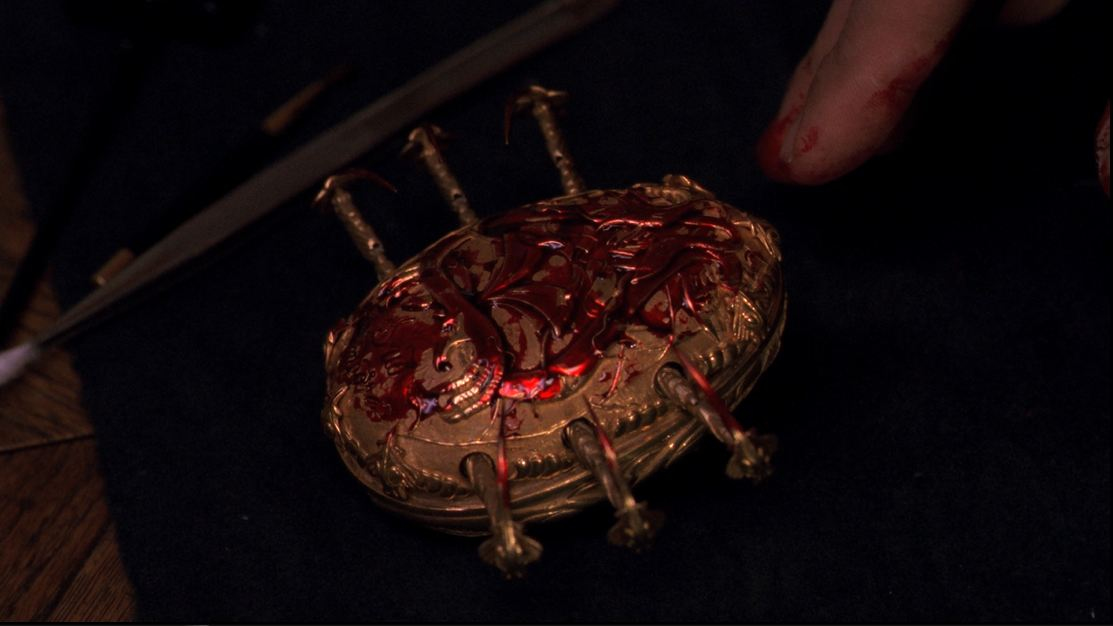
The vision del Toro has of vampirism is one of addiction. There's an earlier scene as Gris allows the device to feed off him in a bathroom, where the device, insect-like, digs metal claws into his flesh, with finally a needle extending from the main body of the device, penetrating the chest and feeding the ancient creature inside (which we see surrounded by clockwork, a motif which would return for del Toro in Hellboy II). Mercedes, his wife, and Aurora (Tamara Shanath), his granddaughter knock at the door, asking if he is ok. He mutters that yes, he will be right out. This is imagery that we've seen before with addicts, who hide their drug-taking in secret, weakened by their use of drugs, coupled with pleasure. 

The most famous scene of the film, and rightly so, sees Gris completely overcome by his thirst for blood, as a party-guest's blood (from a nosebleed) draws to him from the nearby bathroom sink. Another guest complains about the mess, and washes it away, much to Gris' pain. However, a small patch of blood lies on the tiled floor, and Gris, completely overcome, bends to the floor and licks the blood  up slowly. 

This a man at the lowest of the low, and we see the cost of his rejuvenation in revolting detail. At the end of the film, there is a fantastic image where Aurora holds her cut hand to her grandfather in offering, and we see the hunger in Jesus as he craves her blood. What I love about the image is that Aurora holds her hand in a V shape, and the blood runs down the gap of her fingers directly down. It seems to be a visualization of a vagina, one whose virginity has been taken and bleeds. What this does then so brilliantly is again tie back to the sexual nature of vampires, which is otherwise completely ignored in the film, beyond Gris' horniness increasing a little after his rejuvenation (but in a natural human way, rather than a vampiric way). It is even more taboo as it is a dearly loved member of his family, and it would be an abuse of power, not only of body to murder and take her young blood. Gris sees this, and of course refuses her offer, destroying the device. 


His body has been transformed by the device, his skin a white, vampiric one under the old flesh of his human body; his soul however remains pure, despite his nature as a kindly old man taking a hammering along the way - with murder (of Angel), licking of the blood from the floor, and the feeding (in a traditional vampiric way, from the neck - this is where it all came home for me thematically) of Dieter. His soul passes the test of family connections, rape (metaphorically), and addiction with the final destruction of this device. He breaks the chain for future sufferers, and denies himself this unnatural longer life as he realises the final cost it would take from him - his future, in the form of Aurora; a theft of her future and his bloodline, recycled into his own body directly via blood. It is the addict choosing cold turkey, and destroying his stash, indeed, destroying the production factory of the stash! 

The device then is pure del Toro - in physical design with clockwork and unnatural creatures dwelling within, and in soul, as we see his vision of the vampire, and the classic movie monster. Shades of Frankenstein echo in Gris and Aurora, hearkening back to del Toro's own childhood viewing of the Universal monster films. This is a great director interpreting and remixing the mythology of monsters off-screen and on, creating something entirely new, but refreshingly classic in nature.   

Saturday, 29 October 2016

Object #55 - Red high-heels - Tenebrae (1982)

Dir. Dario Argento


Tenebrae blew me away. This film was my first Argento and I've literally bought nearly every film of his I can get my hands on since watching it. For that reason, if you have any intention this Halloween of seeing a fantastically stylish slasher film with a kickass synth soundtrack (No, not Halloween!), then read on only if you don't mind having the twist of the killer's identity spoiled.

...still here? Ok, here we go. 

Now as you would know from a cursory read of the refreshingly in-depth wikipedia page for this film, Tenebrae is a film all about duality. I nearly chose the typewriters as the objects for this film because the duality theme din't actually hit me until I saw them together. There are two killers in the film, the first, who commits the murders of the first half of the film, is reporter Christiano Berti (John Steiner), who is inspired in his own way by the slasher books of author Peter Neal (Anthony Franciosa). The second murderer, as we discover later in the film, is Neal himself, who becomes unshackled mentally by the murders of Berti. 


Earlier in the film, before we have even met Berti, we see a dream-like sequence where a beautiful woman (Eva Robin) leads men to a beach as she undresses slowly. The men crowd around her, and she goes to her knees, feeling the legs and torso of each of the men - almost trying to touch all of them at the same time. In slow motion, one of the men slaps her hard across the face. Licking her wounds, she only has to look at the men, using her sexual power to make them catch the man, now running away. They hold the man down, and she, who is clad in a simple white dress with bold red high-heeled shoes, kicks him repeatedly. She finishes her assault by forcing the heel down the man's throat, raping him orally. 

Take a breather because this is a highly charged image in its own right, even stronger in the scene as a whole. This woman holds such sway over the men, yet remains an object to be abused physically. Her sexual allure is so strong however that this societal 'weakness' as a woman is turned on its head, and her beauty is enough to turn men her slaves, co-operators in her shaming of the man who took a step too far in the face of her beauty. She uses the brutal sexuality of the man against him, forcing her heel into his mouth, raping him as he would have done to her. There is an undercurrent of homosexuality, as if he's being forced to suck a dick, but this is harsher, as the heel in an inherently feminine object, and so it is doubly humiliating as it is feminization via masculine, somewhat gay imagery. 


As Neal goes on to murder later, we see a second flashback in the first person, where the woman in white is stabbed in, presumably, revenge by the abused man. This flashback takes place during Neal's 'section' of the film, as he goes on his murder spree, and so we are to presume that these flashbacks are his own history - he was the abused man. His murders against women by fictional characters in his novels are, like Berti believes wholeheartedly, subconscious victories against women as a whole, due to the acts of this one woman in the past. So to are his murders now, and indeed this is manifested directly in his gift of red high-heeled shoes to his ex-wife Jane (Dario Nicolodi), who is later murdered by Neal for having an affair with his publicist, Bullmer (John Saxon) - who he has already publicly murdered at this point in the film.

Jane's death is remarkably violent, as Neal bursts through the window with an axe, chopping her hand off as it sprays blood across the wall. She is stabbed in the cheat over and over by Neal off-camera, and it is here we are revealed the identity of the second killer, Neal. Here the flashbacks are 'explained', and the motive of Neal made clear. He directly emulates the death of the woman who abused him, by not only eliminating his cheating ex-wife, but also the abusing woman symbolically, as Jane wears the red heels, and wears a white dress that becomes stained with blood.


It's a truly horrible death, as are most in the film, but this one is remarkably sadistic and brutal, as are all of Neal's murders in comparison with the colder calculation of Berti's. It is because of the awakening of this repressed memory of Neal's that the murders come passionately, and are more primal, using many different objects such as axes, rather than the shaving blade of Berti's. Again, it is through duality and comparison that the brutality of Neal is highlighted. Of note also is that within the second flashback, it isn't clear if the murder of the abusing woman is truth or the revenge-fantasy of the young Neal - a fantasy fulfilled in his novels, and in his murders now.


The film has Argento playfully respond to critics of his early giallo flicks, who stated that he has a problem with women as his films such as Cat O'Nine Tails always had beautiful women killed in gruesome detail. The scene earlier in the film has a critic of Neal directly use this argument in Neal's novels - except here the critics are correct, his novels are subconscious manifestations of his hate towards women. Do I think Argento is 'owning up' to hating women in the film? God no. Argento has no issue with women, but I love the playful meta-nature of the film, as Argento almost vilifies these critics, almost saying that "Yes - you are right. Let me make a film about it." 

P.S I was pleasantly surprised to learn that the musical theme of Tenebrae, performed by Goblin and featured best in the scaling crane-shot of the two lesbians' house early in the film, was sampled (surprisingly directly) in French electro-duo Justice's song Phantom. It's a kickass song and one I've enjoyed a lot before even knowing it was a sample. Put it this way, Justice have great taste in not only film, but film soundtracks.     


Friday, 28 October 2016

Object #54 - Mill wheel - White Zombie (1932)

Dir. Victor Halperin


It's impossible to talk about White Zombie without mentioning Romero's Night of the Living Dead (1968). White Zombie is technically the first zombie film - ever. The zombies are referred to by name, are people who have been brought back to life from death, and are mindless. They are best illustrated in an early scene, where the local sugarcane mill is discovered by Charles (Robert Frazer) to be run entirely by the zombie-thralls of Voodoo master Murder Legendre (Bela Lugosi) - yes his first name is actually murder. 

Here, the zombies are not brought back to life from death by radiation (as hypothesized by scientists in Night of the Living Dead), or via a biological virus (a-la most zombie films). In White Zombie they are thralls of a skilled practitioner of voodoo, a mystical belief system that, at least in the film if not in reality, can control the minds of both the living and the dead - being so powerful a will in Murder's case, that the dead themselves are compelled to return to 'life' to obey him. This 'life' is representative of what we know about the classic Night of the Living Dead zombies, at least in part - they have no free will, cannot speak beyond grunts and moans, walk slowly, and can commit murder. 


Differences abound however - they retain abilities from before their death, most notable in Madeline (Madge Bellamy) who can play the piano beautifully as a zombie, but with no passion or spirit, and more widely in the 'workers' of the mill, who carry baskets, and operate machinery such as the mill wheel. More modern zombies have 'evolved' in their own way to reflect this characterization, some even using guns, such as in the Resident Evil franchise (both games and films). My favourite example of this is in the first season of The Walking Dead where one zombie has a 'routine' of returning to its home, and looking through the peep-hole of the door. Here, there are none of the common zombie tropes: no bites turning the living into zombies, no cannibalism, and no brain destruction completely killing the zombie (although this is more a case of lack of opportunity in the plot in White Zombie) - all, incidentally, introduced by Romero, a fact which deserves more credit than is given - it's astonishing how much one man's vision of the living dead continues to this day. 

But White Zombie has power in its own right - best shown here in the mill scene. In their filmic introduction, the zombies - a word completely new here, already predict the behaviours that we find to be 'zombie'-like in our common parlance - that is, mindless and passionless activity. Edgar Wright parodies it in the brilliant opening of Shaun of the Dead (2004) where we see shop-keepers, kids playing with footballs, dancing youths (etc.) perform activity in such a way that it is robotic and completely inhuman.

The zombies of White Zombie provide a warning in their very inception, that horror is being a slave, that horror is performing actions without passion, that horror is murder done on the behalf of others. These are modern horrors - working a robotic (that word again - perhaps the modern version of this zombie archetype?) job in a factory, watching day-time TV vegged out on the sofa, even the gym where exercise is stationary and regimented. Koyaanisqatsi (1982), a film I've covered on the blog in the past, deals with this existential horror - with scenes of factory and supermarket workers performing the same actions over and over and over. 

Zombies would go on to be meaner, and act more as personifications of death itself, a symbol that persists as most prominent to this day, being a prime source for interpretation, best seen in the entire Living Dead franchise. But in White Zombie the mindlessness of the zombie is the largest horror, the worst thing imaginable in the film seems less to be the zombie's ability to kill you, and more the fact that the zombie can play the piano as well as when it was alive - but with no shred of humanity, no soul. Coming back from death is impossible without this core cost of soullessness, and it remains a perversion, a slavery to a voodoo master. In our modern day lives, if we feel zombie-like, then we have to ask - who is our master?

P.S Both White Zombie and Night of the Living Dead are in the public domain and legally free to watch and even sell copies of. I've linked the wikipedia links to the films here which contain the entire films - free to watch. Just in case you're bored this Halloween season! 

P.P.S I realize that last sentence is very teenage-angst, anti-authoritarian bullshit, but does have some truth in it. Although the best rebuttal to that point of view is Bob Dylan's You Gotta Serve Somebody

Tuesday, 25 October 2016

Object #53 - Sheet - The Conjuring (2013)

Dir. James Wan


Nerdwriter has a fantastic video on Batman v Superman: Dawn of Justice where he discusses the 'fundamental flaw' of the film, that being, that it's a film full of effective moments, normally shot extremely well, but no effective scenes. His videos are well worth a watch, even if you disagree with some of them, but this one I think he nailed. Moments such as the court-room explosion, a crowd reaching out to Superman like a deity, Batman's reveal where he clings to the roof of a seedy building - all great moments that come to my mind right now, but no scenes that could be described as that scene, crucially, not even the fight between the two heroes. 

The Conjuring has the same flaw, however in no way to the same extent. There are moments you may remember - the floating chair, the matches being lit in the basement, and the sheet silhouetting the malevolent spirit. However, I wouldn't really describe any scene as being a stand-out, mainly, because I feel most of the 'moments' are either cribbed from other horror films directly, or cribbed technically, usually via framing or camera movement. For example, when the mother, Carolyn (Lili Taylor) goes into the basement for the first time after hearing a noise, a red ball springs from the corner and spooks her. Now to me that moment seems to be a direct homage to the famous scene from The Changeling (1980), where the red ball rolls down the stairs of the haunted house of its own will. I trust James Wan to have seen that film (I mean come on, of course he has, surely) and it seems more likely to be a nice little homage, rather than a 'rip-off'.  

The scene from The Changeling
The horror genre tends to be very self-referential in nature, very reactionary to other films and formats of horror, and I'd argue again that the moment towards the end of The Conjuring, where the possessed birds attack the house has a lot of Hitchcock's The Birds (1963) in it's DNA. The found-footage craze, dying out nowaydays(ish), is evident in the use of the first-person viewpoint, as the crew film the visits in the basement. The entire film has little moments and shots that seem to call back to past horror, but the one moment, it's a little too short to call a 'scene', that I think is completely new, and completely effective, is the moment with the sheet, which you can view here


Lorraine (Vera Farmiga), one of the paranormal investigators, is hanging up some washing for the family. We've had encounters with the malevolent spirit at this point, and just earlier there's a nice character moment between Lorraine and her husband (Patrick Wilson) where they lament that they don't have a nice house and family like this one. The cloud close in, darkness falls, and the wind picks up. Lorraine reaches for a white sheet, but it flies from the washing line, and very briefly, it is caught on top of a humanoid figure - the spirit, silhouetted. The music spikes, and the form of the spirit is lost, as the sheet blows to the upper window, and then blows away. This brings Lorraine's attention to the figure in the window above, the spirit, possessing the mother. 

It's a very sudden moment, not wholly unexpected due to the change in weather, but nonetheless surprising as it's a very unique shot, one that couldn't have really been done prior to the proliferation of CGI. It's damned scary, and what I love more than anything is how it turns that classic image of ghosts - a floating sheet - into something very scary. We've all done it as kids, thrown a blanket with eye holes over you head, and raised your hands going 'OOOohhh'. We've all seen it in Scooby-Doo

From Scooby-Doo
This is the main moment from The Conjuring that I feel stands alone, and will be remembered at that moment from the film. Now, if I think of the great classic horror films, they tend to have a few of these great moments: e.g The Thing (1982) - the defibrillator scene, the blood-testing scene, the dog in the cage; The Exorcist (1973) - the Crucifix masturbation, the head turning 360 degrees, the 'Power of Christ compels you' scene; The Shining (1980) - the twins, the woman in the bath, the hedge maze.; etc. etc. So, I don't know if The Conjuring has enough stand-out moments to make it that memorable over time, and arguably I have to ask - should it? Is the power of a film in moments or in scenes? Does a consistent creepy, scary tone out-weigh a few standout creepy moments?

Time will tell I suppose. From my experience, one moment in a film can usually be enough to earn some life-long fans. Cult films thrive in the horror genre, and even if they don't enter the pantheon of horror as films like The Shining do, they still inspire young filmmakers, are still loved, and of course, still scare the crap out of you! 

Monday, 24 October 2016

Object #52 - Family Table - The Texas Chainsaw Massacre (1974)

Dir. Tobe Hooper


No, I'm not being purposefully contrary and not choosing the chainsaw as the object for this film. ok, maybe I am a little bit. So why the family table and not the chainsaw? Well:

The horror of The Texas Chainsaw Massacre is encapsulated to me in two things, two central things, with a hell of a lot of subtext underneath. Those two can be symbolised by the chainsaw, and the family table. Personally, I find the family table to be scarier. 

i) The Chainsaw: Primal, raw energy. Leatherface (Gunnar Hansen), who we see has little more mental development than that of a child, using heavy machinery to chase teenagers through an old house and a field. The horror is of a twisted child, completely let loose with the ability to kill you with a rotating saw of death. This is physical horror, tied to the weapon, and tied to the location - bumfuck nowhere U.S.A, where nobody can here you scream - and oh boy, is there a lot of screaming. 

The second half of The Texas Chainsaw Massacre is almost wall-to-wall with sound, mostly the screams of 'final-girl', Sally (Marilyn Burns), the revving of the chainsaw. It's exhausting to watch and listen to; it assaults you, a feeling that the film excels at. The scene that always strikes me as I view the film, is when Sally and the disabled Franklin (Paul A. Partain) are come upon all of a sudden in the treeline surrounding the abandoned house. Leatherface, clad in his iconic butchers apron and skin-mask, slashes his chainsaw into Franklin, who is helpless to escape.


Sally screams, naturally. Now what a lot of people get wrong about the film, is that it's bloody or gory - it isn't. The early kills involve a meat hook and a hammer, yes, but not much blood is shown. Here, despite it actually being plausible, only some blood spatters Leatherface's apron. If that freaks you out, don't worry about it here. 

Sally runs through the tree-line, screaming and bashing away branches, and Leatherface pursues, grunting and slashing his chainsaw clumsily at the branches to clear a path. Sally runs and runs and runs, and all we experience is pursuit. To me, this is fantastic horror, and horror at the most basic level. You went for a trip with your friends, a murdered picks you off one-by-one. You see the last of your friends, the cowardly Franklin, torn apart in front of you by this demented killer, and you are now completely alone, in a field, with this human monster chasing you. This could happen, it's damned unlikely, but your daily life could be visited by a crazed murder. In the final scene of the film this returns as the car/truck drivers see this insanity, and are all of a sudden fighting and fleeing for their lives. That's what I think the chainsaw symbolises - the primal horror that all of a sudden, like most of the animal kingdom, you will have to flee for your life, or die. All that stands between you and death is a maniac with a weapon, in this case, a chainsaw.


ii)  Family Table: I touched on it above actually, because that's my bias. The other horror of The Texas Chainsaw Massacre is the notion of the twisted family. After the scene above, Sally reaches a gas station, and begs the owner (Jim Siedow) to call the police. Eerie silence sets in, as Leatherface does not burst through the door (brilliantly framed constantly to the right of Sally, making you anticipate the door being burst), but a worse fate comes, as the owner restrains Sally - this bastion of safety has been subverted, and it is revealed that the owner is part of the Leatherface family, being an older brother, alongside the hitch-hiker (Edwin Neal) seen earlier. 

Sally awakes, restrained, at the head of a family table, pictured above is her point of view. At the opposite end is the grandfather (John Dugan) of the family, seen earlier but believed dead, who wares a face-mask, likely made from skin and dyed white. Leatherface has gussied up, with blusher and lipstick placed on his, well, leather face. It is a parody of the wholesome American family. The house is full of bones, animal and human, Sally's friends are in a freezer down below, and even the chair she sits on has human hands on the arms of it. It is distorted, and disgusting. The food served is likely human meat from past kills - there is a history of violence and insanity that seems to be imbued in the house itself.    


Sally begs for her release and is mocked by the hitch-hiker, and there is a fantastic montage of close-ups of Sally and the family, particularly Sally's eye-ball, which bulges in fear and horror at the situation she has found herself in. The family has the subtext of being butchers, however whether they were originally and became murderers, or used the techniques to dispose of the bodies is unclear. But what this achieves is a link to the slaughterhouses of the American South, the South also traditionally associated with more backwards social views, and the importance of family, and also, being rural and isolated, as we can see here as this family can operate with no worry of discovery or of anyone hearing the screams of their victims. This is reinforced by the gas station owner being part of the established world, with a job and responsibility, while also gleefully taking part in this twisted life.

The Grandfather also carries with him untold backstory, and the impression I got was that it's he who twisted his boys to join his psychopathy, bringing them into the fold to kill travelers and innocents. What this carries with it is generational history, these murders have been occurring for decades and it's now that we have the endpoint- Leatherface, an ugly child who is a monster through and through. After his first two kills in the early part of the film, Leatherface is shown frustrated by the act, and stomps around the living room, sitting down with this head in his hands - it's actually sympathetic. He is a victim of his family upbringing, only able to express himself by lashing out and killing, or through the adopted persona (subextually at least) of his leather-face. He is pitiable, but horrifying. 


The moment that is most revolting sees Sally's finger cut to drawn blood, and the grandfather wheeled over so that he can suck on the blood. This is where we see for sure that the grandfather is still alive and despite his age and weakness, he seems to take pleasure from the taste of the blood - again, giving us a wealth of untold back-story. Sally is naturally horrified at this perversion. She is the only woman here, and I think this is a parallel to breastfeeding, again tying it back to family, but so twisted as it is done with blood, by force, and given to the eldest member of the family. We see in Sally's eyes the fear of rape from the family, and indeed the thought is terrifying, particularly from Leatherface, however I think this is the true rape, as her body is sucked from by the decrepit old man. 
Later the younger members try and help him to have one last kill, hammering Sally's head but he is too frail to carry it out - it's almost compassionate and inclusionary to an older family member but as ever, is completely twisted. Similarly twisted is the 'female' presence of Leatherface, as his make-up colours him as either the mother of the group, or a daughter - and this in and of itself just shows how mentally ruined he is by this family - with no female presence to balance out this family, we can only wonder what happened to the mother, or mothers, of these children.

Both types of horror are fantastic in this film, but I think the family table, as a symbol of traditional American family-values being perverted is the most strong. It is the psychological perversion of this family unit by the grandfather, and the end-point of this perversion, Leatherface, that are truly horrifying, as it is harder to write off as the insanity of one murderer, but rather, the legacy of insanity throughout the years, and the notion that insanity can be passed on. The iconic final image of the film hammers this home, as the stunted child-like Leatherface dances with the chainsaw in silhouette against the sun, frustrated at the escape of his prey: a temper tantrum, with a chainsaw.


Tuesday, 18 October 2016

Object #51 - Hourglass - Jules and Jim (1962)

Dir. Francois Truffaut


The first 30 minutes of Jules and Jim are a whirlwind of images. In quick succession we are introduced to Jules (Oskar Werner), and (you guessed it), Jim (Henri Serre), the two city-goers, not doing much at all- sleeping with women, fencing, and viewing slideshows of ancient statues. That last one does seem a little unique, but that's the beauty of this rapid opening, you just have to roll with it as a viewer, with scenes swapping locations and topic nearly every minute; it's dizzying even to our modern eyes who are used to rapid cuts, particularly in our blockbusters. The two go to view one of the statues, as the smile of it has captured their interest, and here they meet a woman, Catherine (Jeanne Moreau) who looks just like the statue - thus enrapturing them both.

 We have already seen that Jim has a partner, Gilberte (Vanna Urbino), as well as Jules' sexual exploits prior to meeting Catherine. In one of these scenes Jules, a shy Austrian, is in bed with Therese (Marie Dubois), and he turns over a large hourglass, telling her that by the time it has run out, he'll be asleep. In a fantastic bit of symbolism, one that's endemic of Truffaut's entire approach to film, that is - mixing it up a bit, Therese takes Jules' cigarette, and smokes it backwards, circling the room blowing smoke, pretending she's a train. It's sex without showing sex, as the two fall into bed right after, with the sand falling...


As Jules and Catherine enter a relationship, Jim is told "Not this one" - clearly told that she is off limits both sexually and romantically to Jim. But of course, we love what we cannot have, and Catherine is certainly lovable. Jeanne Moreau is the star of the show throughout the film, as her giddy, take-what-come nature in the early section of the film is beautifully played, and indeed shot by Truffaut. The first screenshot above is actually paused within the scene itself, freezing the beauty of Catherine as she laughs at Jim/Jules' jokes. It's techniques like this, as well as the use of voice over (such as later on when we are told that Jim is in love with her as she dives into the river), that do so well what 'traditional' film does only with dialogue and 'standard' shots of events. By freezing moments of laughter we see that Catherine is beautiful throughout the entire action, as well as hammering home the fleeting nature of the action itself. This is why I chose the hourglass as the object for this film, as it symbolises the theme of the film for me - that theme being time, or more specifically, how relationships and people can change over time.


The catalyst for this change is the First World War, which Jules and Jim fight in, on different sides. This however is glossed over quickly with historic footage, and the rest of the film not really bringing it up, except as a reason for dividing the trio. Post-war, Jim visits Jules and Catherine in Austria, their new home, where their live with their young child, Sabine (Sabine Haudepin). The spectre of the war hangs over them however, not with PTSD or lost limbs, but as a wall between their old, care-free city life, and their current life in the countryside, as parents, and older men/women. Jim and Catherine do sleep with each other eventually, and we learn that Catherine has been cheating on Jules prior to this, a fact he's aware of. The majority of the film then focuses on this relationship triangle, as Catherine and Jim sleep together upstairs most nights, with Catherine occasionally spurning Jim, and being wooed all over again by Jules more restrained nature.     

The hourglass in fact, survives the war, but isn't used, only sitting in the back of scenes. Similarly, a painting Jim gave as a gift at Catherine and Jules' wedding also sits in the background, a survivor of the war, and an anchor to a better time. The relationship of Jim and Catherine degrades over time, as jealousy and distance erodes their passion. But as their love was so passionate and strong, it takes a long time for this to happen, as even in jealousy, neither man can stay away - best exemplified in a scene where they drive her to Albert's (Serge Rezvani), an on/off lover of Catherine's, and leave her the night there, with the car to drive home. 

Jim and Jules
The message of the film may be that time can degrade all things, including relationships. I think however the power of the theme is in retrospect, as the giddyness of the opening of Jules and Jim, both in plot and filmic construction, is that much more powerful in contrast to the end-point - Jules, alone, with the ashes of his friends, and the mid-point, the degrading relationship of the three. Shots are slower at the end, cuts less frequent, and the freeze-frame, frozen in time shots of a young Catherine laughing seem worlds apart from her openly asking Jules, who sits in his rocking chair, if Jim loves her?