Monday, 10 August 2015

Object #35 - Mirrors - The Guest (2014) / Mad Detective (2007)

Dir. Adam Wingard / Johnnie To & Wai Ka-Fai 


Double feature! I've wanted to do a double feature for a while but only now had the opportunity due to some lovely parallels between two films I've recently watched, Adam Wingard's 80's throwback-thriller The Guest, and Johnnie To and Wai Ka-Fai's unique, supernatural-tinged Hong Kong police procedural Mad Detective. (Also check out, if you'd like, my last double feature of sorts, on two versions of Les Miserables.)

What I intend with double features is to show how the same object in different films can convey completely different ideas. Mirrors are common enough objects that you'll find them in many, many films, but I wanted to write about both these films anyway, so here we are. With The Guest, the mirrors in question are placed as part of a haunted house attraction for the local school Halloween party. At this point in the film, Major Carver (the never-terrible Lance Reddick), and Anna (Maika Monroe) have escaped the murderous rampage of the titled guest, David Collins (Dan Stevens), who killed Anna's parents, special agents out for his capture, and, just for kicks, a diner full of civilians. David, as Major Carver explained to Anna on the way to the school, is a modified super-soldier who is compelled to kill any person who finds out his identity. To cut a long-story short, Anna and the Major are on the way to the school to ensure the safety of Anna and her brother, Luke (Brendan Meyer). 

Wingard sets up the haunted house by having Anna and the Major move their way through the various sections to reach Luke, so that when David arrives to hunt them down, we understand the geography of the location, a smart move, as the maze-house is, as you'd guess, confusingly set-up. The Major is dispatched quickly, as is Luke's substitute teacher, as David, with all his military skill, strikes from behind the mirrors. Their images are multiplied on and on, which gives David a sense of omnipresence, as if he's everywhere at once, and can strike from any location. He has been portrayed as a powerful figure throughout the film, muscled, skilled with guns and knives, and efficient in his intelligence. Now, on the run, he uses the maze and mirrors to his advantage. 


But what I find most effective about the final scenes is how they essentially parody horror films, particularly slasher horror-films, like Halloween. It's blatant from the beginning, with the film's opening - a shot of a pumpkin-head scarecrow, informing us that Halloween is near, and although the film isn't really a horror film for the most-part, this final sequence takes on all the tropes. The fleeing teenager, the all-powerful pursuer with murder as their goal, the maze itself, calling back, in my mind, to Kubrick's The Shining. It's great stuff, and The Guest isn't really meant to be taken seriously at face-value, Wingard himself has said this. Hell, even the neon-soaked cyberpunk soundtrack, with it's heavy synths calls back to the soundtrack of Halloween. The entire finale takes on the air of parody, or simple meta-ness (is that a word?). 

The ending of the film, with David's (eventual, again, another trope) death via Luke's fatal stabbing is not a few minutes later dropped, with David escaping the scene, having taken the disguise of a firefighter. Anna lets out a loud "What the fuck?" as she notices it's David, back from the dead, the super-soldier now set-up to be something more, something supernatural, exactly like those slasher killers like Freddy Krueger, or Jason Voorhees. We cut to the credits, and it's clear that the film is having fun with the downright silliness of it all. Frankly, it deserves to, as it fulfills it's purpose fantastically, to be an 80's throwback thriller. The mirrors then, to overthink it completely, with the many reflections of David could represent the multitude of times we've seen these types of slasher murderers, and will likely see them again. ...or maybe I've been watching too much Battlestar Galactica.  


Again, during the finale of the film, mirrors have an important role in Mad Detective. Bun (Sean Lau), former detective is different to everyone else, in that he can see the 'inner personalities' of people, and has used this in his career to great acclaim to solve murders. That is until he cut off his own ear to give as a retirement gift to his superior. Throughout the film, we are shown what the suspect looks like in reality, and then a personification of their inner personality is shown and heard, but only to Bun. In an earlier scene in particular, rogue cop Chi-Wai (Lam Ka-Tung) is shown at a urinal, but not as himself, but as his gluttonous inner personality, which switches to the executive inner personality, which controls his behaviour. At this point in the film, Bun follows Chi-Wai and fellow detective Ho (Andy On), with the intent of stopping their murder of Naresh (Singh Hartihan Bitto), which will cover-up Chi-Wai's crimes; except Ho is only there to arrest Naresh, not kill him. Look, to put it simply, it's exactly what you'd expect from a Hong Kong police thriller - complicated.

  
 What To and Ka-Fai do with the climactic scene is have some visual fun. As Chi-Wai walks past mirrors that are placed in the room, we see reflected some of his seven inner personalities. It doesn't need to be there, but then again, in a film this visually inventive, the scene would be lacking something without it. Visually, there are people pointing guns at people pointing guns at people pointing guns, on and on, and it shows us, instead of telling us (ah, that old adage!) that there are so many conflicting personalities in a person, each with their own motive, culminating in one person, whole, yet made of many. As the shoot-out occurs, the mirrors are shot, and it conveys a sense of each character's inner personalities dying, mostly Ch-Wai and Ho. Each shot is a nail in the coffin, coming closer and closer to reaching it's target. The complexity of the film is reduced with each shot, as the personalities disappear visually, the plot has done so as well; now, we have a shoot-out, simple. The shoot-out ends with a Mexican stand-off between the four, with their guns pointing at each other, and finally each person shoots the person they want to. In the end however, all except Ho lie dead on the floor, and we have them surrounded by the broken shards and fragments of the mirrors. The shattered mirrors are broken, just like the bodies of the four, as even Ho is injured. 


The complexity of the film lost in the shoot-out resurfaces as Ho rearranges the guns, as it's maddening trying to remember who has who's guns in the first place (this is one of the films' main plot-drives) and where they are being placed by Ho, and what this means. Thematically what it means is that Ho has become just like Chi-Wai, a rogue cop, who has inherited the executive woman as part of his inner personality, comforting his inner, innocent child-like spirit. 

Mirrors then, in both The Guest and Mad Detective are there to be visually stimulating, but they also convey a hell of a lot more ideas about each film. Self-reflection is normally associated with mirrors and it's interesting that in these two films, it isn't really what they are about. Even in Mad Detective it isn't self-reflection, but a reflection of the self. 

Monday, 27 July 2015

Object #34 - Alpha-Omega Bomb - Beneath the Planet of the Apes (1970)

Dir. Ted Post


Beneath the Planet of the Apes is quite possibly the weirdest sequel to a major film I've ever seen. The film is quite obviously done on less of a budget, with crowd scenes of the apes looking particularly shoddy due to poor mask work, as opposed to the stellar make-up/mask work on main ape characters. The lack of budget hangs over the film, and a lack of creativity permeates the first half of the film. Brent (James Franciscus) is on a search mission for first film protagonist, Taylor (Charlton Heston). Brent crashes his ship, discovers the mute human, Nova (Linda Harrison), discovers the ape civilization, meets kindly apes Zira (Kim Hunter) and Cornelius (David Watson), and discovers that human society has been destroyed by witnessing the remains of New York monuments - stop me if you've heard this one before. 

But it's from here on that the film becomes it's own, but oh boy is it weird! To step back a little, the film opens immediately after the iconic "You blew it up!" scene from Taylor. Taylor and Nova ride their horse further into the Forbidden Zone, which already feels odd as there's such a distinct feeling of 'Why am I watching this?', as in, why are we continuing a story directly after it's reached the twist climax? The message of the story is done, there's not much more to be done with Taylor as a character, nor the plot. To the film's credit, it realizes this and has Taylor fall into an invisible chasm in the rocks after witnessing a fiery wall. Then Brent's story re-hashes the original film's plot. 

Franciscus is a dead-ringer for Heston, and it really does feel like a poor-man's Planet of the Apes for around 50 minutes. But we've already seen Heston in new scenes! Why bother having the initial continuation? It's only there to explain how Taylor winds up in the city later in the film, and explain how Nova got away. This could so simply have been re-written! The scene with Nova meeting Brent, with Taylor's dog-tags tipping him off to Taylor's existence could have been kept, in fact, in would add a nice sense of mystery to Brent's proceedings. The only thing lost is the introduction of the fire-wall. It's really shoddy, and a very weird opening to the sequel of a majorly successful film.


After the re-hash, Brent and Nova discover a group of humans in the remains of New York city. They wear robes, appear emotionless, and can mind-control Brent and Nova to hurt each other. No you didn't miss anything, that's what happens! First of all, humans. In Planet of the Apes, particularly the ending scenes with the doll in the cave and of course, Lady Liberty herself, we are told that humans are long gone, long gone. An entire ape society has evolved since the nuclear war, and any humans left have devolved to lose their ability to speak, and act as the 'apes' of our time. Humanity, as we know it today, is gone. But here, it isn't. These humans, somehow, have survived the war, and have retained an air of civilization in this desolation. This undercuts the original film and the superb ending, as we know that just around the corner, in the Forbidden Zone, this group of civilized mutants were going about their business.

The humans have mutated to such a degree that they have psychic abilities, such as mind-reading and thought-control. If this sounds like a rip off of a Star Trek episode you're not far off, as the series was running at this time and has similar plots in some of it's episodes, such as Plato's Stepchildren, broadcast in late 1968, where all-powerful aliens control the minds of the Enterprise crew for their own entertainment. It really dives the up-until-know mature Twilight Zone/Star Trek vibe of the the series into the lower annals of those two shows, and is more of a direct rip off then ever, becoming kitschy and unrealistic. It is moderately unique however, as our object, the Alpha-Omega bomb, leads to some iconic and homageable scenes of their own.


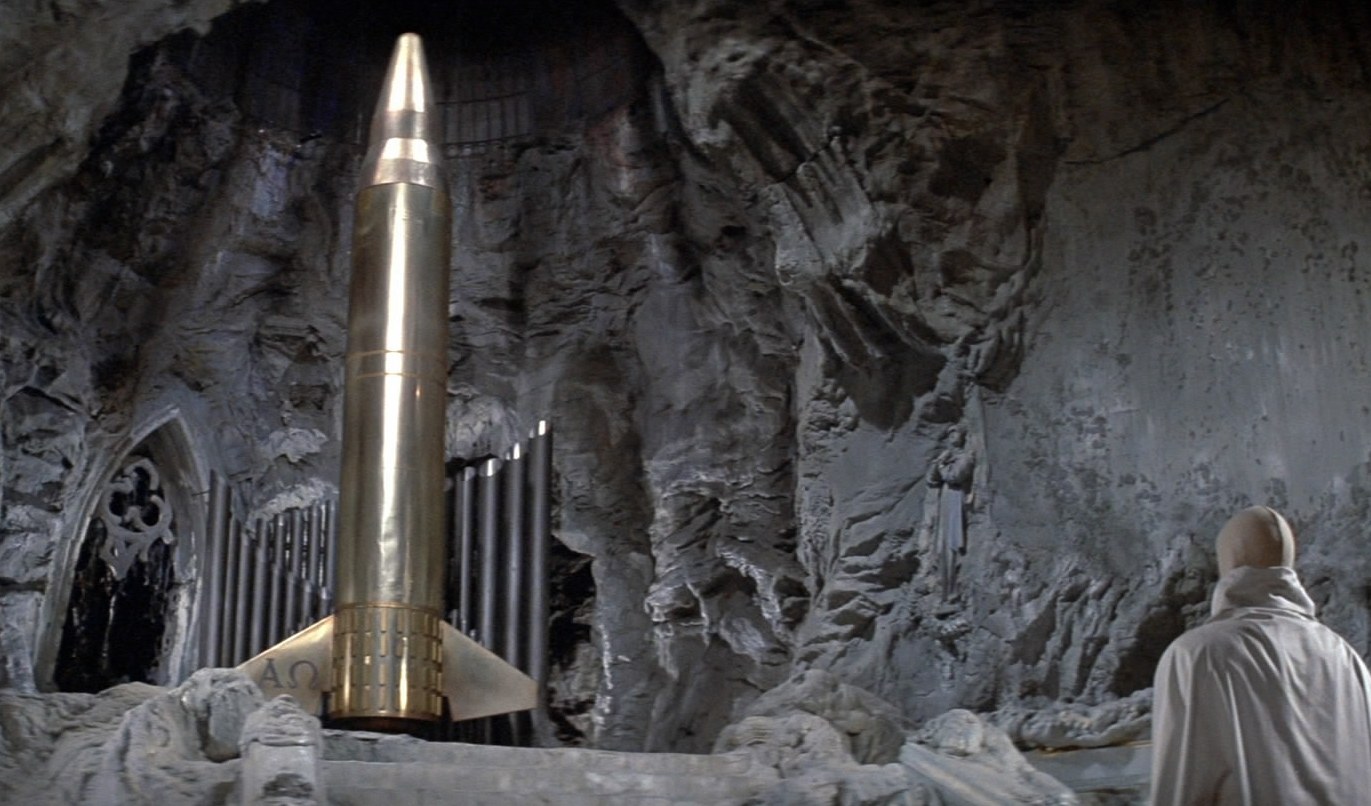
The mutants worship an ancient nuclear bomb, with a congregation of worshipers who sing hymns to the tune of an organ, wear ceremonial robes, and in their moment of exaltation, remove their human masks to reveal their mutated, nuclear scarred faces. It's striking imagery, but not for all the right reasons. I normally hate criticizing a film for plot elements as it isn't the most important thing in my opinion, but here it's remarkable. So this is a nuclear wasteland, and yet these mutants have a working church, built into the rock, somehow have constructed masks to cover their mutations, and have also possess books, organs, and in later scenes, statuettes of their leaders. What?! Where did their find the materials for all this? Why would they bother creating the masks if they've no contact with other humans or apes? If they are descendants of human survivors of the war, then I doubt they even know what a regular human looks like, and if so, why would they care to look like them if all they've ever known is their mutated selves? If it's a religious thing, and they want to ascend back to the 'perfect' human, then why exalt in the mutation in the service? How did this religion even come to be? So many questions, some best left to the imagination to have some mystery and sense of prior story, but most need answering, as they detract from the plot and the world. 


And yet...that's sort of the point. It's so bold in the allegory it doesn't care to focus on the details. The themes and visuals are so strong that they become iconic. It's clearly a biting satire of the 'worship' of the nuclear bomb that won the Allies the Second World War, but also the 'worship' of it in 1950's American culture. It's no wonder that these mutants are referenced in the third game of the Fallout series, with the Church of the Children of Atom, as that series portrays a society that thrived using nuclear power, yet kept the 1950's values. The bomb, called the Alpha-Omega bomb, the beginning and the end, is the only way these mutants keep sane in this world, through worshiping the symbol of death and new-life. Their human lives were changed by the bomb, mutating their bodies yet enhancing their mental abilities, but crucially, not their intelligence. They believe they will become one with the world via the exploding of the bomb.

As this goes on, the apes invade the Forbidden Zone and storm the ruins and the church. It's downright surreal! Humanoid, intelligent apes with guns vs. mutant atomic-bomb worshiping humans, with Brent, Nova, and Taylor (two of which are out of time) caught in the middle. 


The bomb is damaged, and has enough energy to destroy the entire planet. In rapid succession, Nova is killed by the apes, Taylor is shot, and Brent gunned down after managing to shoot down the gorilla General Ursus (James Gregory). This is the end for these characters, who admittedly we've known for a short amount of time but it's shocking nonetheless in brutality. Taylor pleads with Dr. Zaius (Maurice Evans) for help stopping the bomb, but Zaius remains stuck in his ways, saying that man is only able to destroy. 

Taylor falls, gasping out "It's Doomsday" as he hits the detonation switch with his bloodied hand.
The bomb rumbles, we pan in on his hand, it slips, a white light fills the screen, then darkness. A voice-over tells us "In one of the countless billions of galaxies in the universe, lies a medium-sized star, and one of its satellites, a green and insignificant planet, is now dead". Then the credits roll, in silence. 


...WHAT? That's the ending, not only of this film, but to all the films in the series as they all take place chronologically behind Beneath. It's bold, bleak, and incredibly abrupt. In this surreal war-scape, main characters are removed brutally, they act not out of character, but out of character with the entire tone of the original film, and even the re-hash elements of this sequel. Would Taylor really want to exterminate this world after his extreme reaction to the ruins of Lady Liberty? Is this all Brent deserves, to be shot in this climactic battle for the entire fate of the world? But this battle doesn't feel that climactic, it isn't deserved by anything that comes before, it feels like a skirmish in the Forbidden Zone with some mutated freaks, which is exactly what it is. If it wasn't for this Alpha-Omega bomb which, incidentally, we are never informed how came to be, or be found, or survive the initial nuclear war, this would be a small, incidental battle.

The abrupt voice-over, the first use of it in the film, brings the matters of the world to a cosmic level, which jarrs with what we are seeing, and have seen throughout the film. This is how the Earth bites the bullet? Really? The beauty of the original film is that the climax of humanity happened in the past, leaving an interesting world behind. Seeing the event happen again in this way is not only unsatisfying, it's uncalled for, and with the voice-over we know there is no future at all this time. If this is the point the film is trying to make, that nuclear war would be the end of the Earth, then it squanders the fascinating allegory of the apes for no good reason. It's shocking, bold, unsatisfying, yet unshakable in the memory. 

Sunday, 26 July 2015

Object #33 - The Worst Toilet in Scotland - Trainspotting (1996)

Dir. Danny Boyle 


Well this one was inevitable wasn't it? One of the most recognizable and iconic objects in all of film, the as-titled 'worst Toilet in Scotland' is a revolting thing, and shows us the lengths our protagonist, Mark Renton (Ewan McGregor) will go to continue his addiction to heroin. Thanks to Miramax, you can watch this scene in glorious HD here.

Mark has purchased suppositories to fulfill his hit, and has inserted them anally. He tells us in a voice-over that one of the (as we will see in the film, many) downsides of heroin addiction is constipation. His last hit is fading, the suppositories haven't taken effect, and so he, to but it bluntly, needs to shit, very very badly. He runs, doubled over, to the nearest toilet, residing in a betting shop. The patrons stare at this skin-head junkie, as Renton fantasies of 'a massive, pristine convenience'. What he's met with...isn't.


There's a few things at play stylistically. Boyle has a fish-eye type lens used as Renton sees the patrons stare at him. Their leering judgement is amplified this way, and we get a sense of Renton being an 'other'. The way Renton sets up his fantasy of an ideal bathroom and toilet is very much contrasted by the toilet he finds. The titles that infrequently appear in the film do make an appearance here, overlain on the sides of the hanging 'Toilet' sign, to tell us, with full hyperbole, that it's the worst toilet in Scotland. Honestly, I'd be hard-pressed to disagree. 

The room is filthy. Broken taps and urinals, covered in dirty water, the water itself full of mud, piss and shit. No seat on the toilet, grime and shit caked into the porcelain, the water brown. Renton, revolted, has no other choice, an attempt to flush is met with a broken chain, he has to sit, relieving himself in bliss. Then he realizes to his horror that the suppositories have been lost in the process, so he gets on his knees and searches with his hands in the foul, soiled water, retching as he does it. 


We then get a mark of brilliance, which is what makes this scene so unique. As he searches and searches, Renton begins to climb and fall into the toilet basin. It's clearly impossible, and is a fantastical representation of what this search feels like to Renton. Whimsical, classical music begins to play from the opera Carmen (you'll know the one) as Mark falls into the toilet, legs sticking directly up, comically. 


In the water, the music is similarly uplifting. It makes Renton's trial to retrieve his suppositories an epic affair, as he swims in clear water to a rock floor, finding the drugs he needs, letting out a bubbled cry "Yes, I'm fucking dancing!". It's utterly fantastical and once again, contrasts with the revolting bathroom. The music swells as he re-emerges, a hand at first, then a head spitting water, gasping for air. 


We cut to Renton, in his room, walking to his table, with suppositories in hand. He tells us "And now...I'm ready". He's ready for withdrawal, and after what we've just seen, boy does he need it!

Trainspotting is a film that deals with the allure of heroin addiction, and how, when addicted, the world seems bright, and yet when sober, the world is bleak. The title refers to this, as the hobby of trainspotting seems utterly pointless to an outsider, and yet to an enthusiast, it makes complete sense. Heroin addiction is the same, and the film deals with this in detail, with the death of an infant, and the haunting of this loss life during withdrawal as the absolute low-points, as well as, of course, the toilet scene. 

The toilet scene acts then as a sort of prelude to the themes of the film, a fantastical simplification occurring soon after the bold 'Choose life', Lust for Life opening. We see how far into the dirt, and the literal shit, that Renton will go to have one final hit. How good must this drug be, to be worth all this? Clearly, good enough. Again, as outsiders, it seems ridiculous to imagine anything worth this much trouble, but again, that's the point. 

The almost religious Valhalla conveyed by the clear water Renton swims in, the music, and the shininess of the suppositories, white - pure, like the taps in Renton's fantasy bathroom, tell us that through drugs, Mark reaches a state of ascension, not beyond his horrific surroundings, but through them. 

Tuesday, 21 July 2015

Object #32 - The Tunnel - Willy Wonka & the Chocolate Factory (1971)

Dir. Mel Stuart


There's no earthly way of knowing
In which direction we are going.
There's no knowing where we're rowing,
Or which way the river's flowing!
Is it raining, is it snowing?
Is a hurricane a-blowing?
Not a speck of light is showing,
So the danger must be growing.
By the fires of hell a-glowing,
is the grisly reaper mowing?
Yes! The danger must be growing,
For the rowers keep on rowing,
And they're certainly not showing,
Any signs that they are slowing!
The ability of children to take things in their stride is a unique quirk of being young. Now I know this isn't the case all of the time, as everyone knows a child who questions absolutely everything. But with films, it tends to be, at least in my own experience and from the experiences of people I've known, that kids can accept the most off-the-wall things without much questioning, particularly if watching a film alone. The tunnel scene in Willy Wonka & the Chocolate Factory is the prime example I find.

You likely know the story already, either from the classic Roald Dahl book, this film, or even the 2005 Tim Burton adaption. Willy Wonka (Gene Wilder), the reclusive and eccentric chocolatier invites the finders of five golden tickets, with an escort, to tour his famous chocolate factory. Inside, they find delights of 'Pure Imagination', with rivers of chocolate, everlasting gobstoppers, and the Oompa Loompa helpers.

Early in the film, after being wowed by Wonka's auditorium, full of edible mushrooms and the chocolate river, the children and their family member escorts ride a boat on the chocolate river, taking them deeper into the factory. What, before this, has been a magical film, with musical numbers such as 'The Candyman', 'I've Got a Golden Ticket', and 'Pure Imagination' (also 'Cheer Up Charlie', but nobody likes that one), takes a turn for the surreal, the psychedelic, and the frightening.


The scene is here, in poor quality. They enter the dark tunnel, with both parents and children shouting their displeasure, as Wonka tells the Oopma-Loompas to increase speed. The boat, and the tunnel, becomes cast in psychedelic lights of red, blue, and purple. Henry Salt (Roy Kinnear) tells Wonka that he can't possibly know where he's going, to which Wonka responds "You're right, I can't". This is the magic of Gene Wilder in this scene, he goes from absolutely insane, with eyes wide in pure insane joy, to utterly reserved and scheming as he responds to the parents. It's passionate

Not soon after, the horror begins. Lest we forget, this is a film aimed at children and families. Moving images appear on the walls of the tunnel, flashing quickly, registering in your brain and then being cast away by a cut. We see a millipede-like creature crawl over a woman's mouth, as she appears unmoving; we see a chicken, and an axe fall, decapitating it; a reptile eating a bug; and a maggot extend it's mouth. Also, of note, is that Charlie (Peter Ostrum) sees an image of Slugworth (Gunter Meisner), the rival of Wonka who asked the winners to smuggle out one of Wonka's creations for a business advantage. Charlie and Grandpa Joe (Jack Albertson) are the only two who aren't completely frightened by the tunnel, and so there's a suggestion that as Slugworth appears to Charlie, that the tunnel is reflecting the fears of the boat-riders back at them. This could be wrong of course, as most of the images are universal in their ability to disgust and revolt us.


Wonka begins to sing, see the lyrics above. He paints a picture of hopelessness and loss of control, as both he, the owner and imagination behind the factory, the Oompa-Loompas (all the only authority figures in the factory essentially), and the boat riders are hurtling out of control at high speed. He taps into the fear everyone feels, as even the Oompa-Loopmas row and row, as they want to escape the fearful images. It's so primal, and so at odds with everything we've seen in the film so far that we honestly have no idea what will happen next. Wilder plays it as a slowly increasing mania, until he crescendos with a wild scream, the light flashing around him, the people he's welcomed into his home screaming in terror.

The fact he mentions hell brings to mind a theory I read online, which in typical internet fashion, is fairly outlandish and not the intention of the story, but is interesting nonetheless, that the tunnel is a pathway to either Hell or Purgatory, as the fearful images welcome them to the land of death and hopelessness. The children are then judged appropriately by Wonka as the story unfolds, each falling to a sin, Gloop - gluttony, Violet - pride, Veruca - greed, Mike - sloth. Charlie, who remains mostly honest, passes the test of offering the Gobstopper to 'Slugworth', and is accepted into a glass elevator, which takes him upwards into Paradise. 

I love that theory, it's not the intention of the film or the book at all, but it lines up near-perfectly and actually solidifies a lot of the themes Dahl was going for in the book. It's why I like the tunnel scene so much, as the mention of Hell subconsciously brings this to mind over the course of the film. It's also an addition to the film not present in the book. 


Henry Salt pipes up again, telling Wonka that this has gone far enough. Wonka replies far more rationally and calmly "Quite right, Sir. Stop the boat!". We cut to black, and the shot above is shown. No inertia of the boat stopping, they simply have arrived at their destination. It really does make it feel like they've all shared a bad LSD! Also of note, is the fact that Wonka did actually have the power the entire time to stop the boat. He was in control, despite his song, and so he orchestrated the event for his own end, for his own pleasure. It's a startling start to the tour, and perhaps this is what Wonka was going for in his insane head, but it's clear that they've now found their way, and that anything coming after this is unlikely to be as frightening as what was just experienced.

In all honesty, you don't need to go into much depth to see why the tunnel is such a unique and fascinating part of this film. For a children's film, it's adult, scary, and as I said earlier, primal. It sets a wavelength for the boat-riders but also we the audience, that this is a factory, a world, that plays by it's own rules. Are you ready for the tour?  

Sunday, 12 July 2015

Object #31 - Mannequins - Killer's Kiss (1955)

Dir. Stanley Kubrick


Killer's Kiss is a fascinating little film, literally, it has a brief 67 minute run time, not much longer than a modern episode of TV. It's fascinating for being the second feature film of the cinematic virtuoso and legend, Stanley Kubrick, director of such masterpieces as 2001: A Space Odyssey, Barry Lyndon, A Clockwork Orange, and Dr. Strangelove or: How I Learned to Stop Worrying and Love the Bomb. Killer's Kiss however is the product of a younger, 26 year-old Kubrick, and his technique hadn't been refined to its eventual peak. Kubrick himself shunned his first feature, Fear and Desire, for it's amateur nature later in his life. Killer's Kiss is only once removed from that, and it isn't until his third feature, the superb heist film that is The Killing does Kubrick begin as a true filmmaker. But that's what makes his early work so fascinating, to see the rough edges of a future master!

As you'd expect there are flairs of brilliance. In Killer's Kiss, it's mostly the cinematography of the piece. Kubrick, a renowned photographer, particularly due to his age, knew how to shoot New York in such a way as to capture the essence of the place. 

[ASIDE: I've often wondered if you watched every single film set in a big city whether you could truly know the city. The same with massive world events such as World War 2. Take the duality of Flags of Our Fathers and Letters from Iwo Jima, both envisioned by Eastwood to explore this idea. If we compared Saving Private Ryan, a modern Hollywood take on the war, to the older, slightly hokey John Wayne films like Sands of Iwo Jima, we'd call Saving Private Ryan the more realistic. But neither are, both are hyper-real in their own ways. And more to the point, the beauty of films like Sands of Iwo Jima is the way the American filmmakers (and indeed British, and other Allied countries) portrayed the war a short ten or twenty years after. Even more to the point, if we analysed Birdman, Killer's Kiss, Manhattan, and Kubrick's later staged version of New York in Eyes Wide Shut, which is the closest to the real New York? Of course, the answer is, all are valid, even films merely passingly set there, like The Avengers, tell us something about how the city is considered in the popular psyche, and indeed the director's. I may write a separate post about this in future, as frankly, I think it's fascinating.]

It's unfortunate then that in his final film Eyes Wide Shut, Kubrick made New York feel so unnatural by using sets. This choice was made out of necessity, as he hated flying and was now permanently living in Britain. Also, famous perfectionist that he was, I believe Kubrick preferred the use of sets as he could control every aspect of it. In Killer's Kiss, due to budgetary reasons, the film was set on location, and so New York is real, but it's in how Kubrick chooses to frame it that makes it interesting. 


In typical ObjectsInFilm fashion, I've gone and spoken a lot about something I don't want to really talk about! My point was that Killer's Kiss has some, not many, but some aspects that reflect his later, more refined, and well-received work. Also, that it's beautifully shot, and should be watched on that merit alone. The scene I wanted to discuss comes near the end of the film, it's the climatic fight between Davey Gordon (Jamie Smith), our main character, a lightweight boxer who wants to run away with Gloria Price (Irene Kane), and Vincent Rapallo (Frank Silvera), the gangster employer of Gloria, who has kidnapped her. It's a simple premise, if Davey kills Vincent he can run away with Gloria, but if Vincent wins, he will likely escape the police with Gloria in tow. You can watch the fight here.

The two fight in a mannequin factory, with various mannequin models scattered in various states of disarray around the factory floor. The mannequins achieve a few things in the scene, the most obvious and physical is being used as props, as fighting implements between the two before they find deadlier weapons. More interestingly, is the subtext that the use of mannequins have. You can see from the screenshots that the mannequins are almost always in shot during the fight. Their lifeless faces look on, disinterested in the fight. What I feel this reflects is the sense that the affair that is being fought over, Gloria, is a dime-a-dozen in New York. The 'crowd', unlike the crowd of the earlier boxing match, have no investment in the outcome of the fight, as they, like the inhabitants of New York, are merely background figures in the game being fought.


 This is true of any film set in a city, the denizens are normally passers-by, each with their own stories but none that factor into the plot of the films we are watching. By having the mannequins in the background of the scene, Kubrick is reminding us of the setting of the film, and the world at large, and how little each effect the relationships at play. New York won't care who wins the fight, as Davey, Vincent, or Gloria don't care about any of the citizens of New York outside their respective social circles. By casting unknown actors as Davey and Gloria, this feeling is heightened, as the actors are as unfamiliar to us as the characters they are playing, and so there is no baggage to disconnect.  


The other aspect, and I think the most salient and obvious, is the fact that nearly all of the mannequins are female. As the two men fight, they use women figures as weapons, destroying their opponent bit by bit, but also the women-figures in the process. It isn't men who suffer in the game of love and lust, but women. They are used as objects here, just as they are objectified in 1950's New York, as the end-goal of men, both romantically, as shown by Davey, and sexually, as shown by Vincent. Gloria is a woman, with her opinion of little value in the matter. I watched the 2005 version of Pride and Prejudice lately, and the same themes arise there, and what makes it such an interesting and enduring novel (and ergo the adaptions) is the fact that Elizabeth Bennet does have agency and choice, despite the time the novel is set. In Killer's Kiss however, New York is portrayed as a place to be gotten out of by Davey and Gloria, so that their love can bloom free. New York, civilization, is where the women are objectified, showing us as modern audiences (and let's not take the high horse here, we have a LONG way to go before portraying women realistically in film generally) how backwards the 1950's was, despite the fact that New York, a bastion of old-age modernity had been chugging along for many a decade. 


My final point is a superficial one, but just one I thought should be noted. The use of mannequins in Killer's Kiss seems like a pre-cursor to the most obvious use of an object in Kubrick's filmography, in my opinion, the penis sculpture from A Clockwork Orange, one I may eventually write a post about in future. It shows us that Kubrick understood how objects could be used as symbols of deeper themes. The most interesting thing, I think, is that they are normally quite obvious and overt. The use of female mannequins as weapons would seems quite amateur of Kubrick if he didn't go on to use just as obvious a symbolic object, the penis sculpture in A Clockwork Orange. Let's not beat around the bush here, Kubrick wasn't above a cheap gag when using objects, as some certain genital-shaped lollipops can attest...


Monday, 29 June 2015

Object #30 - Coffin - Nosferatu (1922)

Dir. F.W Murnau 


'Say “Dracula” and you smile. Say “Nosferatu” and you've eaten a lemon.' - Roger Ebert
 This quote from the great critic Roger Ebert sums up the difference in tone that Nosferatu has from any other Dracula adaption. Most adaptions of Bram Stoker's Dracula fall prey to camp, particularly, well, Bram Stoker's Dracula, directed by Francis Ford Coppola and featuring such oddities as Dracula's stylized armour (which may well be a post in it's own right in the future). Even Tod Browning's Dracula (1931), starring Bela Lugosi in the iconic role, has since fallen to near-parody, as it's the inception of nearly every trope later used to parody vampires and Dracula films. The Hammer Horror Dracula films, well...need I say more?

Nosferatu, by virtue of being adapted so early in the history of film, feels like the origin of the beast that is Count Dracula, or rather, Count Orlok (Max Schreck). Nosferatu has name changes due to the filmmakers being sued by Bram Stoker's descendants for creating an unauthorized adaption of the novel, and so Count Dracula becomes Count Orlok, vampire becomes nosferatu, etc.. It's a miracle the film survived, as all copies were ordered to be destroyed. Thankfully, oh so thankfully, the beast lives on. This production fact I think adds to the mystique of the film, as if the film itself hid in a coffin somewhere, in the dark, waiting to emerge.


The coffin is central to the story of Dracula, as you likely know. It's almost impossible to not know the story of Dracula these days, due to the novel being a well-read classic and plenty of adaptions through the years. Nosferatu is special however as Orlok seems more synonymous with his coffin than any other adaption. Throughout the film, the coffin is never far away. It's where he sleeps at night, in that classic pose, but we've become so dissolusioned to the image of a vampire in a coffin that we forget the obvious. The Vampire is undead, and lies in the coffin, a symbol of death in our culture. He sleeps in it, our beds are a source of comfort to us, but to Orlok, his coffin is where he rests at night. He rests among death. Death and the vampire are synonymous, via the coffin.


Orlok in particular in this adaption personally carries his coffin with him. Like a hermit crab, he takes his 'home' with him everywhere, literally carrying death with him at all times. In one scene, which you can see here, Hutter (Gustav von Wangenheim) sees Orlok leave his castle, placing the coffin on a carriage, opening it, climbing in, and by supernatural means, telekinetically placing the lid atop himself. He is ready for his journey across the sea to the England. In the boat, the sailors open one of the coffins, and it's filled with rats (I'll come back to this point).


Later, the sailor returns, ready to open Orlok's coffin and we get this iconic image. Orlok rises from death, alive, but as a personification of death. Even more-so, as when he arrives in England, the deaths that occur to state his hunger are attributed to plague rats from the ship, themselves a symbol of death. Importantly, Orlok takes his own coffin with him in this new land, literally carrying death with him. 

I mean look at this other iconic image: 


The shadow of death, in profile, is horrifying. It's still, yet with clawed fingers outstretched, ready to take life as it moves unnaturally about it's business. As is typical with vampire stories, it's lust for a woman that trumps the monster. Here, rather than the more loving relationship of vampire and prey as explored in more recent media, it's the classic element of lust. Orlok drains Ellen's (Greta Schroder) blood all night, so engrossed that when it becomes daytime he vanishes in a puff of smoke, defeated. 

The sexual undertones are obvious, and ingrained in the vampire mythos, and it's refreshing that in this nearly century old film, it's lust that characterizes the beastly Orlok, not love. We've matured in our age to humanize the vampire, but here, it's a legend, a tale to terrify children, warning them of the sexual predator that is synonymous with death. A monster that lives and sleeps in death, in a coffin, ready to emerge, to hunt, to kill, and take pleasure from it. 
'Those things that live only at night do not need to talk, for their victims are asleep, waiting.' - Roger Ebert

Object #29 - Piping - Aliens (1986)

Dir. James Cameron


Androids in films have had some interesting portrayals. Ridley Scott portrayed the android Ash (Ian Holm) in Alien as a human for all intents and purposes, of course that's the point, yet Ash turns glitchy, and become an Other: milk-blooded, surviving great damage, and utterly relentless when the human 'facade' fades away. Scott, of course, also directed Blade Runner, likely my all-time favourite film (Final Cut, naturally), and brought to the screen the fantastically complex androids, headed by Roy Batty (Rutger Hauer), whose 'Tears in Rain' death-speech remains one of the most beautiful things in any media I've ever seen. Hauer's portrayal fills Batty with eccentricities, which carry over to the other androids, but it's Batty that is the most human android of them all. In the Final Cut of the film, having Deckard (Harrison Ford) be an android really hammers home how truly human, or rather 'More Human Than Human' Tyrrel-Corp have made their androids. 

There have been other androids in media, with the Cylons of Battlestar Galactica on TV, Ava (Alicia Vikander) in the recent Ex Machina, and David (Michael Fassbender) in Prometheus, (Scott's return to the universe of Alien). You can see critic Mark Kermode discuss his top five artificial people here, a list I mostly agree with. Kermode selects one artificial person in particular, the android Bishop (Lance Henriksen) from James Cameron's Aliens

In the sci-fi action film that is Aliens, Bishop shines as a character, no small feat in a film that has created action-character archetypes, due to great and iconic side-characters such as Vasquez, Hudson, and Apone. Bishop is more than human, with increased speed and precision as evidenced in the knife scene near the beginning of the film, and Cameron plays with the inherent 'evil' of the android, based on our knowledge of Ash from Alien, and twists it, with the cowardly company-man Burke being the traitor of the group. That in itself makes Bishop a more reliable character, but the prime moment that shows off how human Bishop really is, is the pipe scene.


Trapped in the colony, our heroes, and our main hero Ripley (Sigourney Weaver) are told by Bishop that the colony's power plant has been damaged in the Xenomorph attack. It's apparent that the only possible route to the power plant is via hundreds of meters of narrow, tight, piping. The goal is to get to the power plant and resolve the issue, which requires some extra tech taken with. Bishop volunteers for this. And this tells us a lot about the world and Bishop himself.

If anything, it's almost expected of androids to do such duty, as that's what they're designed for, as intelligent workers that can move cargo, solve tech problems, and, frankly, do all the little jobs that humans would rather not. Yet, none of the characters have this bigotry, and if so, don't express it. Bishop sees the problem in a logical, android way. He is less likely to panic, and he's the best suited to solve the tech issue on the other end. And oh boy, is there reason to panic. The way he moves down this pipe is by shuffling, and shifting his body along, pushing the tech in front of him. I don't suffer from claustrophobia, but I'd dare anyone to take on this duty. Crawling through kilometers-long piping, with only a torch as a light-source, in a facility crawling with deadly aliens out for your blood, be it artificial or not. 


But Bishop volunteers for this. Even though he's guided by logic, it's a brave act, a human act. But most importantly, a selfless human act, one that goes beyond the pettiness of humans, the panic, the selfishness, and goes straight into 'More Human Than Human' territory. The androids are the best humanity can offer, and yet they aren't human. Due to many early films dealing with androids, including Blade Runner, and Aliens, this has become a trope, but an important one. So much dystopia, not excluding Cameron's own Terminator, portrays technology as the downfall of humanity, yet in Aliens and numerous others, androids become the best of us, the true humans. The piping in Aliens facilitates this, and atop that, is an iconic and fascinating shot, with Henriksen's face eerily lit and the unfamiliar movement, coming directly into the screen, making the shot all the other interesting and unique. 

Bishop goes on to become even more of a hero, returning to save Ripley from the exploding colony, and even when torn apart by the Xenomorph Queen, he reaches out to grab and save Newt (Carrie Henn) from the certain death of the vacuum of space, once again using his android qualities to be utterly selfless and heroic. In Aliens there are characters to aspire to: Ripley, who uses her inherent humanity and femininity to become a badass action hero; Hicks (Michael Biehn) who does his duty and more; Vasquez (Jenette Goldstein) who gives her life to save others; and, of course, Bishop, who despite his artificiality, becomes, to overuse a phrase, 'More Human Than Human'.