Thursday, 15 October 2015

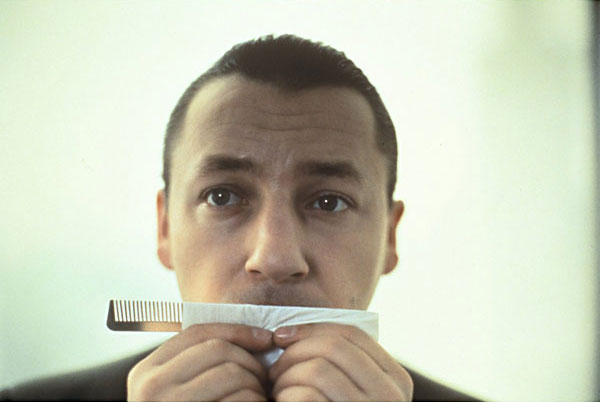
Object #41 - Comb - Three Colours: White (1994)

Dir. Krzysztof Kieslowski


Kieslowski's Three Colours trilogy is some of greatest drama I've seen put to film. With Tokyo Story in the last post, I seem to be gravitating towards human dramas lately! Unfortunately, I fall in with the general opinion that White is the least effective of the three films, with Blue and Red shifting in my estimation depending on my mood, Blue usually wins out though. All three films have a heavy focus on objects as symbols, as well as colour, naturally, and so it felt right to finally add one of them to the blog.

If you don't plan on watching White, then watch this video from the sublime Criterion Collection, which acts as a sort of visual guide to the film. It also includes a brief clip of the scene with the comb. Stranded in Paris, penniless, (well, he has a two franc coin, an important object in and of itself) abandoned by his wife (Julie Delpy), Polish-born Karol Karol (Zbigniew Zamachowski) has to sing through a comb to beg for any change the Parisian underground travelers will offer him. Luckily, a fellow Pole, Mikolaj (Janusz Gajos), offers him a plan to return to Poland. 


To be brief, and to quote, Jack Sparrow "complications arose, ensued, were overcome". Karol re-established himself in Poland, and turned to a life of crime. Now don't get the wrong idea from that sentence, it doesn't suddenly turn into a gangster film, but nonetheless, Karol grows through crime with his business partner Mikolaj. Their relationship is a complicated one, with suicide, murder, and soul-searching involved, but all you need to know is that they have a deep history, tracing all the way back to the underground in Paris. 

The moment the comb comes around and serves a greater purpose is around 2/3rds of the way into the film. Karol now uses the comb (it isn't clear if it's the same comb, but it is likely), as, just that,  a comb. He is suited, with slicked-back hair, a man of means. He has risen from that underground and now finds himself in a new high-rise building he's bought thanks to his business dealings. He turns to Mikolaj, pulls out the comb and a handkerchief, and hums the very same tune.  


This moment comes about an hour after the underground scene, after many plot and character developments, but this object, and the world of difference in the context in which it's used, brings us right back to the empty, hopeless world Karol began from. It is a symbol that with the right help, and a bit of luck, a man can make himself anything. 

The theme of the film is equality, as denoted by the colour white, based on the French flag. This taps into that, with every person being equal to make something of themselves, just as they are equal to have some beneficial luck. The equality theme extends to Karol's wish for revenge against his wife, with him wanting to leave her just as alone and hopeless as he was. Does he succeed? Go watch the film and find out!     

Compared to some of the other objects from the entire trilogy, the comb is relatively simple. I like it nonetheless and I'm likely at some point in time to return to the other two films in the trilogy. Honestly, I think the comb is only so simple in the context of the trilogy. Kieslowski is so very good at what he does that he has numerous objects in the same film that act as symbols, have resonance, and this is atop his masterful use of colour (he really does sell the concept of a colour theme for liberte, egalite, and fraternite). These are superb films in every right: cinematography, acting, score, every single aspect of the film is on-point, with a slight script and editing sag in White. As you can tell though, it's still a very subtle and nuanced film, and one that can stand equal with the other two films in the trilogy, which is of course, quite fitting.  

Tuesday, 13 October 2015

Object #40 - Hand fan - Tokyo Story (1953)

Dir. Yasujiro Ozu 


Ozu's Tokyo Story topped the 2012 Sight and Sound director's poll of the greatest films of all time, and came third in the combined critics and directors poll, behind Vertigo, and Citizen Kane. This is a phenomenally well-regarded film. It gladdens me immensely that a film that only moves the camera once can be so well-regarded by the great directors of the world. This a film that is still. No fancy moving one-shots, no fancy lighting effects, just a camera placed strategically well, and a scene played out by actors. The story is just as simple, two grandparents visit their children and grandchildren for a few days. That's the premise. The only narrative development is that the grandmother, Tomi (Chieko Higashiyama), falls critically ill and dies shortly after their return. 

I've spoken before about how one human moment can redeem a film for me. Tokyo Story, in under two hours, made me mourn the loss of this woman. I genuinely felt a profound sense of loss for the remainder of the film without her. How is this achieved? Human moments, human moments in abundance. I'm actually not going to go into them, because I'd essentially be reading you the script, it's that good. The relationships between the visiting family members will be immediately familiar to anyone who has visited/has been visited by extended family. The reality of the drama is spot-on, and is accurately acted even by the younger actors.


Anyway, I'm blabbing on. The reason I chose the hand fan, or rather fans, from this film is a bit of an obtuse way of discussing how Tomi's death resonates with the audience. Throughout the film, and I really do mean throughout, people use fans to keep themselves cool, naturally. In the beginning of the film, as we are introduced to Tomi and her husband, Shukichi (Chishu Ryu), with them chatting to each other in the gentle, calm way that life partners of a certain age do. No grand gestures of love, the dialogue itself fairly mundane, but it speaks wonders of the deep, deep love the two share. A neighbour walks by the window, and has a brief, neighbourly chat about their going away to visit family in Tokyo. It seems to be a nice routine, and is, again, immediately recognizable to all of us.


Jumping to the end of the film, Shukichi sits in the same room, alone, fanning himself. If you haven't seen the film, then I hope I'm conveying my message here with the structure of this post. For that neighbour, nothing has changed except that Tomi no longer sits with Shukichi. She does know of the death, and sympathizes with Shukichi, but she has no idea of the relationship development Tomi and Shukichi went through with their family in her final days. It's nothing drastic, but it tells us magnitudes about the characters and the family. The most monumental character moment actually occurs due to her death, with Shukichi giving Noriko (Setsuko Hara) Tomi's watch as a memento. He gives this to his daughter-in-law, widowed due to the death of his son, and despite no blood relation, he emphasizes that she was the one who treated the two of them the best during the visit. It's heartrendingly beautiful, and I nearly chose the watch as the object for this reason. I honestly think if I grew up in Japan, where family bonds are so strong, that this moment would be even more powerful. 

So why the fan? Because it's unchanging. People change, people die, people drift from their parents. The fan is a constant in the film despite all the developments that occur. True, there's one less fan in the ending, and true, Shukichi, in his own restrained way is clearly grief-stricken in his discussion with the neighbour: "If I knew things would come to this, I'd have been kinder to her. Living alone like this, the days will get very long". But despite all this change, he still needs to cool himself with a fan, as do others. The fan, to me at least, links the personal story of this family to the wider world of Japan, as well as to the world at large, across time. It's a cliche, but the more things change, the more they stay the same. 

Friday, 11 September 2015

Objects #38 + #39 - Hershey's Chocolate Bar / Mercedes-Benz GLE Coupe - Wings (1927) / Jurassic World (2015)

Dir. William A. Wellman / Colin Trevorrow 


This post has been mulling around in my head since seeing Jurassic World a few months ago, but it wasn't until I recently saw William Wellman's silent-blockbuster Wings (the first Best Picture winner at the Academy Awards) did I have the drive to write it up. This is a sort of combination of two posts so I'll start off with Wings then head into Jurassic World. 

Fairly early in Wings, our two rivals Jack Powell (Charles Rogers), and David Armstrong (Richard Arlen) find themselves in an army tent, situated at an airfield, ready for their pilot's training. In walks Cadet White, played by a scene-stealing Gary Cooper, who, attired in age-defying cool pilot's gear, tells the two of his exploits as a pilot, essentially showing these young soldiers-to-be how cool they can be. He takes out a Hershey's chocolate bar, offers them some, and eventually throws it onto the cot, which we see in close-up. He dons his leather cap and goggles, and leaves to do a few death-defying runs around the airfield, no big deal in his world. We see a close-up of him smiling and nodding at the two.


Not long after, we hear the sound of a plane crash (at least we do on the version I viewed. I believe the sound effects would have been done live in the theater at the time.), and just as we may have expected, White has been killed in the accident. The two are stunned, as are we in spirit as this character, not on screen for five minutes, was so charismatic and likable that it's a shock and a tangible waste. If men like this can die on home-ground, what will the Great War bring? It's a reminder before seeing the epic battle-scenes that war is costly, as good men such as White are destroyed by the war machine.  

Now, here's the extra-crux of the scene. You can view the end of it here. In the wake of his death, the chocolate bar is returned to, in close-up. It lies on the scarf of the now deceased pilot, and that's the point. By focusing on the simple joy of a chocolate bar earlier in the scene, the feeling of loss brought about by the death of Cadet White is deepened, and this is reflected by the characters on-screen as we see the bar abandoned forever. The simple pleasure it brought White is rendered pointless by his death. Or maybe it doesn't, but that's another topic.

The close-up however is quite long, just a little too long to be there for the artistic merit, and is clearly there, lingering, long enough for us to make out the name of the bar, Hershey's. It's product placement! Simple as that. Now if you're on the same wavelength as I was viewing the scene, this can seem quite cynical, as if this (admittedly, fictional) man's death is being used to sell chocolate bars. But actually, if its inclusion was enough to fund the film, as well as acting as a symbol of war's effect on the innocent, then surely it's worth it? The answer is up to you. Personally, I'd say so. The very fact that I can read a fair bit of depth out of a chocolate bar is merit enough really, as I know I'm not the only one who'll have done so.


Jurassic World on the other hand, on the surface level, makes no such artistic merit out of its product placement. Every car in the film is a Mercedes-Benz, to an unrealistic degree, and as you can see above, was used outside of the film as dual-promotion for the car, as well as the film itself. It works both ways. People interested in the car may go see the film to see it vs. dinosaurs (which is exactly what the poster above conveys), and people viewing the film may think "Hey, that car looks cool", and it will stick in their mind when they consider a new car purchase; that's the goal anyway. Does that serve the film's message a jot - no, it doesn't. 

But, and here's the crux, Jurassic World is so chock-full of product-placement (The Verzion Indominus Rex, Beat's headphones, Starbucks - a comprehensive list here) that it becomes artistic. ...stay with me here. The film deals with the demands of the public for fresh, new, entertainment through the genetically engineered Indominus Rex, designed to be larger than a T-Rex, smarter than a T-Rex, and more than anything, more frightening. Frankly, if you came out of this film not reading the subtext of the increasing need for bigger, badder antagonists in film franchises (Jurassic World included, the Spinosaurus being the main offender from Jurassic Park III) then you missed the stupidly blatant message.


I'm not a fan of this film, mainly because it has it's cake and eats it with regard to this theme. "Oh look at us, aren't we clever satirizing Hollywood franchises...hey, look at this cool dinosaur. Look at it! It turns invisible, isn't that cool!". Also, the film is shoddily written (nay, abysmally written), directed, and is really, really generic. It's a by-the-numbers Hollywood film that takes the piss out of itself, and yet has broken nearly every box office record out there. It's literally laughing all the way to the bank, product placement money in tow. The saddest thing for me is that audiences clearly only want dinosaurs vs. humans (with some bonus dino vs. dino action) to keep them amused. Like the audiences at the theme park, they want to see a show, a Mosasaurus, tapped in a tank, eating a shark (ha ha, we're bigger than Jaws - oh fuck off Trevorrow), then they can go home, talk about it for a few days or so, then get on with their lives. Maybe they'll buy a stuffed Mosasaur toy on the way out, or maybe the real audience will buy a Mercedes. 

At the end of the day I'm conflicted. Jurassic World is so garish with product placement that I find it hard to believe Trevorrow let in in without at least trying to make a point. Is that too haughty of me? Or is the point so simple - theme parks are only there to sell you things via entertainment/movies are only there to sell you things via entertainment - that it's just offensive. Films can be so much more than a cheap thrill, funded by large companies. As we see with Wings, the artistic merit can override the intended effect, or rather, work in tandem. You could argue that Jurassic World's product placement does enhance the film's message, and I would agree with you actually. The fact that the film lacks artistic merit beyond this one theme however is enough to sour the entire film for me. Nothing else in the film is potent enough, the militaristic subtext of living weapons, the film franchise satire, none of it. If the only true good, artistic thing I can say about Jurassic World is it's product placement, then this isn't a film for me. The numbers however, disagree, and that's just tragic. We deserve far more from even our blockbuster films than this shallow piece of entertainment. 

Tuesday, 1 September 2015

Object #37 - Spaghetti & Meatballs - Lady and the Tramp (1955)

Dir. Clyde Geronimi + Wilfred Jackson + Hamilton Luske


"Oh this is the night
It's a beautiful night
and we call it bella notte"

Is there a more famous dish in cinema? The spaghetti and meatballs served for Lady (Barbara Luddy) and Tramp (Larry Roberts), combined with the beautiful song 'Bella Notte', is an enduring image of romance years after the release of the film. You only have to hear "This is the night" to be whisked away in your mind to the atmosphere of the romantic back alley.

Honestly this scene is so perfect that I feel writing about it in depth is just clunky and takes away from the beauty of it. But I'm going to anyway because it deserves it; I'll be as brief as possible.


In this one dish, the class barriers are not broken down, they are unified. The scene takes place in the back alley of an average Italian restaurant, run by the boisterous Tony (George Givot), who welcomes Tramp, an enjoyable visit from a stray dog to perk up his night. Tony and his chef Joe (Bill Thompson) prepare a meal of spaghetti and meatballs, not bones as Joe first tires and is scolded for, as this is a romantic date between Lady and Tramp. By having humans buy into this idea is wonderful, as it's incredibly un-cynical and enjoyable, as is Tony's character in general, and the double-act aspect of him and Joe. The candlelit dinner is something that Lady, reflecting her upper class owners, would be expected to take part in on a date. It's classically romantic (honestly, these days, probably due to the influence of this scene which we all view as kids). Having it in a back alley bridges the gap with the lower class, and the restaurant itself is fairly low-rent. 

How the spaghetti and meatballs are used is genius. The accidental kiss that occurs due to both dogs slurping the same piece of spaghetti and meeting lips, is innocent, accidental, and brings the two to their natural end-point. As Lady bashfully turns her head away in embarrassment, Tramp, in a fantastically romantic move, rolls the last meatball with his nose to her side of the plate, a sign that the kiss was exactly what he wanted, and that he feels affection for her. It also does something beyond human, as nose rolling is something dogs do naturally, and so it combines the anthropomorphic human elements of the scene: the table, the candle, so on, with the true animal nature of the pair, which to us humans, is doubly cute, and makes the moment that much better.


Eating spaghetti is also a naturally messy process. We see Lady slurp the string in surprise, breaking down her class, her 'superiority' for this meal, ergo her 'superiority' for a dog of Tramp's class. It informs the two of them that Lady is stepping down, and Tramp's staging of the meal is his way of stepping up. The two classes, unified in love. 

The music is the glue. It's an unabashed love song about savouring the beautiful night, not alone, but with a loved one. "The stars' in their eyes" is a fantastically simple lyric - the 'beautiful' night is brought right down the eyes of the one you love. "The night will weave its magic spell" is right, and it's done here by the magic of animation, humanity and animal-ity (you get my meaning) combined, and of course, music. It taps into every nervous first date we've had, will have, or have yet to have; our love of animals, particularly dogs, as a species; and our deep-down love for an unabashed love song.

Thursday, 13 August 2015

Object #36 - Razor - Koyaanisqatsi (1982)

Dir. Godfrey Reggio


Koyaanisquatsi is an experience. Around the half-way mark, as a shot of a motorway packed with cars is shown, with accompanying music by Philip Glass, I was intrigued, in awe, and more than anything, exhausted. There is no dialogue in Koyaanisquatsi, no plot, no characters. The entire film is composed of shots of nature (primarily canyons), factories, airports, the city, and people. With only these tools, and a fantastically epic, brooding, sweeping score by Glass, I was left exhausted and anxious. It's masterful film-making, and one of the biggest steps in the use of montage since Battleship Potemkin, which I've written about previously. It's also one of the few times where the 'Life out of balance' (this being the translation of the Hopi word koyaanisquatsi) theme was conveyed by the film to me. Why in that shot of the motorway? I couldn't really tell you. I think it may be due to the simply overwhelming feeling of LIFE in those cars. Those are real people in those cars, captured on film, and still being viewed to this day thanks to this film.

This is where the razor come in. Nearer to the end of the film, we begin to see portraits of people, usually walking the street. They can see the camera, and do in fact look at the camera either directly or out of the corner of their eye. Their behaviour shifts due to their observation. This is a psychological and social phenomenon called the Observer Effect.  It's here in Koyaanisquatsi in pure form. Out of the many beautiful shots of people in this sequence, it is the old man with the disposable razor that stood out to me the most.


An aside, Blade Runner is probably my favourite film. At the end of that film, we have the monologue by the dying android Roy Batty. 
I've... seen things... you people wouldn't believe. Attack ships on fire off the shoulder of Orion; I watched c-beams glitter in the dark near the Tannhäuser Gate... All those... moments... will be lost, in time, like [chokes up] tears... in... rain. Time... to die.
This moment of film is the most beautiful I've ever experienced. It has stuck with me since I saw it for the first time, and it will stay with me for the rest of my life. I can even recite it from memory. Due to this, it weaves into my viewing of other films when relevant. In Koyaanisquatsi, in any moment when people are on screen, whether in close up or at a distance, I thought of the final part of that monologue. "All these moments will be lost in time". Here, on film, these moments survive. Look at the above screenshot. It's beautiful. That man's face is beautiful. The bags under his eyes, his hat, the way his jaw slackens as he stares right down the lens of this intruding camera. There are around 10 or so people portraits in the sequence, not including crowd shots. Each is beautiful in their own way. So why the old man with the razor?


Simply put, because it's unique. In this sequence of the film we see shots of factory workers, people driving around the city, and crowd shots, all sped up via time-lapse. It's astoundingly effective, making me think how like ants we appear as our crowd behaviour governs us as an entire species. The only true individuals in these overhead shots of crowds at a train concourse are the ones who chose to stay still in the middle of the crowd for an extended amount of time, but they also pass, in time. Contrasted with this is the slow motion shots of people walking the street, and so we study them, as they are not in a crowd, they are people, individuals. 


The old man with the razor is unique among this crowd. Mainly, due to the brightly coloured razor. He is shaving himself in this public city street, with no care in the world as to how socially acceptable this is. To be honest, it isn't exactly socially unacceptable, but it's unusual. In the context of the film though it comes across as a life-raft of individuality in the sea of interchangeable crowd members. His age though makes me think that this individuality is transient. To be blunt, he'll die sooner than the rest of the crowd, and so it feels pointless. Actually, even without his age, due to the editing of the film, we know that this man will be lost to us. This moment of individuality will be lost not only in the real world, but in the context of the film, as we see another crowd shot, another person in slo-mo, another landscape shot. 

Beauty comes from the fact that this moment was captured, and due to the editing of the sequence, is unique. This man shaving has reached an enhanced meaning due to its inclusion in the film, and this only happened due to him walking the street at this exact moment in time, and choosing to shave at this exact moment. Think of the chain of events that led to this moment being captured. His choice of when to shave at all times in his life for his hair to grow long enough to choose to shave on the street; the documentarians choosing that place to record, and that particular time; and the choice to include this person in the edit, and at this specific time in the film. I love this idea in general, the causal chain-of-events of life.  You know what's really great about Koyaanisquatsi? The very fact that it's acted as a looking glass for this interpretation. Other films do this, but honestly every person who views Koyaanisquatsi will have their own response to it, and to this single moment of a man and his razor.

Monday, 10 August 2015

Object #35 - Mirrors - The Guest (2014) / Mad Detective (2007)

Dir. Adam Wingard / Johnnie To & Wai Ka-Fai 


Double feature! I've wanted to do a double feature for a while but only now had the opportunity due to some lovely parallels between two films I've recently watched, Adam Wingard's 80's throwback-thriller The Guest, and Johnnie To and Wai Ka-Fai's unique, supernatural-tinged Hong Kong police procedural Mad Detective. (Also check out, if you'd like, my last double feature of sorts, on two versions of Les Miserables.)

What I intend with double features is to show how the same object in different films can convey completely different ideas. Mirrors are common enough objects that you'll find them in many, many films, but I wanted to write about both these films anyway, so here we are. With The Guest, the mirrors in question are placed as part of a haunted house attraction for the local school Halloween party. At this point in the film, Major Carver (the never-terrible Lance Reddick), and Anna (Maika Monroe) have escaped the murderous rampage of the titled guest, David Collins (Dan Stevens), who killed Anna's parents, special agents out for his capture, and, just for kicks, a diner full of civilians. David, as Major Carver explained to Anna on the way to the school, is a modified super-soldier who is compelled to kill any person who finds out his identity. To cut a long-story short, Anna and the Major are on the way to the school to ensure the safety of Anna and her brother, Luke (Brendan Meyer). 

Wingard sets up the haunted house by having Anna and the Major move their way through the various sections to reach Luke, so that when David arrives to hunt them down, we understand the geography of the location, a smart move, as the maze-house is, as you'd guess, confusingly set-up. The Major is dispatched quickly, as is Luke's substitute teacher, as David, with all his military skill, strikes from behind the mirrors. Their images are multiplied on and on, which gives David a sense of omnipresence, as if he's everywhere at once, and can strike from any location. He has been portrayed as a powerful figure throughout the film, muscled, skilled with guns and knives, and efficient in his intelligence. Now, on the run, he uses the maze and mirrors to his advantage. 


But what I find most effective about the final scenes is how they essentially parody horror films, particularly slasher horror-films, like Halloween. It's blatant from the beginning, with the film's opening - a shot of a pumpkin-head scarecrow, informing us that Halloween is near, and although the film isn't really a horror film for the most-part, this final sequence takes on all the tropes. The fleeing teenager, the all-powerful pursuer with murder as their goal, the maze itself, calling back, in my mind, to Kubrick's The Shining. It's great stuff, and The Guest isn't really meant to be taken seriously at face-value, Wingard himself has said this. Hell, even the neon-soaked cyberpunk soundtrack, with it's heavy synths calls back to the soundtrack of Halloween. The entire finale takes on the air of parody, or simple meta-ness (is that a word?). 

The ending of the film, with David's (eventual, again, another trope) death via Luke's fatal stabbing is not a few minutes later dropped, with David escaping the scene, having taken the disguise of a firefighter. Anna lets out a loud "What the fuck?" as she notices it's David, back from the dead, the super-soldier now set-up to be something more, something supernatural, exactly like those slasher killers like Freddy Krueger, or Jason Voorhees. We cut to the credits, and it's clear that the film is having fun with the downright silliness of it all. Frankly, it deserves to, as it fulfills it's purpose fantastically, to be an 80's throwback thriller. The mirrors then, to overthink it completely, with the many reflections of David could represent the multitude of times we've seen these types of slasher murderers, and will likely see them again. ...or maybe I've been watching too much Battlestar Galactica.  


Again, during the finale of the film, mirrors have an important role in Mad Detective. Bun (Sean Lau), former detective is different to everyone else, in that he can see the 'inner personalities' of people, and has used this in his career to great acclaim to solve murders. That is until he cut off his own ear to give as a retirement gift to his superior. Throughout the film, we are shown what the suspect looks like in reality, and then a personification of their inner personality is shown and heard, but only to Bun. In an earlier scene in particular, rogue cop Chi-Wai (Lam Ka-Tung) is shown at a urinal, but not as himself, but as his gluttonous inner personality, which switches to the executive inner personality, which controls his behaviour. At this point in the film, Bun follows Chi-Wai and fellow detective Ho (Andy On), with the intent of stopping their murder of Naresh (Singh Hartihan Bitto), which will cover-up Chi-Wai's crimes; except Ho is only there to arrest Naresh, not kill him. Look, to put it simply, it's exactly what you'd expect from a Hong Kong police thriller - complicated.

  
 What To and Ka-Fai do with the climactic scene is have some visual fun. As Chi-Wai walks past mirrors that are placed in the room, we see reflected some of his seven inner personalities. It doesn't need to be there, but then again, in a film this visually inventive, the scene would be lacking something without it. Visually, there are people pointing guns at people pointing guns at people pointing guns, on and on, and it shows us, instead of telling us (ah, that old adage!) that there are so many conflicting personalities in a person, each with their own motive, culminating in one person, whole, yet made of many. As the shoot-out occurs, the mirrors are shot, and it conveys a sense of each character's inner personalities dying, mostly Ch-Wai and Ho. Each shot is a nail in the coffin, coming closer and closer to reaching it's target. The complexity of the film is reduced with each shot, as the personalities disappear visually, the plot has done so as well; now, we have a shoot-out, simple. The shoot-out ends with a Mexican stand-off between the four, with their guns pointing at each other, and finally each person shoots the person they want to. In the end however, all except Ho lie dead on the floor, and we have them surrounded by the broken shards and fragments of the mirrors. The shattered mirrors are broken, just like the bodies of the four, as even Ho is injured. 


The complexity of the film lost in the shoot-out resurfaces as Ho rearranges the guns, as it's maddening trying to remember who has who's guns in the first place (this is one of the films' main plot-drives) and where they are being placed by Ho, and what this means. Thematically what it means is that Ho has become just like Chi-Wai, a rogue cop, who has inherited the executive woman as part of his inner personality, comforting his inner, innocent child-like spirit. 

Mirrors then, in both The Guest and Mad Detective are there to be visually stimulating, but they also convey a hell of a lot more ideas about each film. Self-reflection is normally associated with mirrors and it's interesting that in these two films, it isn't really what they are about. Even in Mad Detective it isn't self-reflection, but a reflection of the self. 

Monday, 27 July 2015

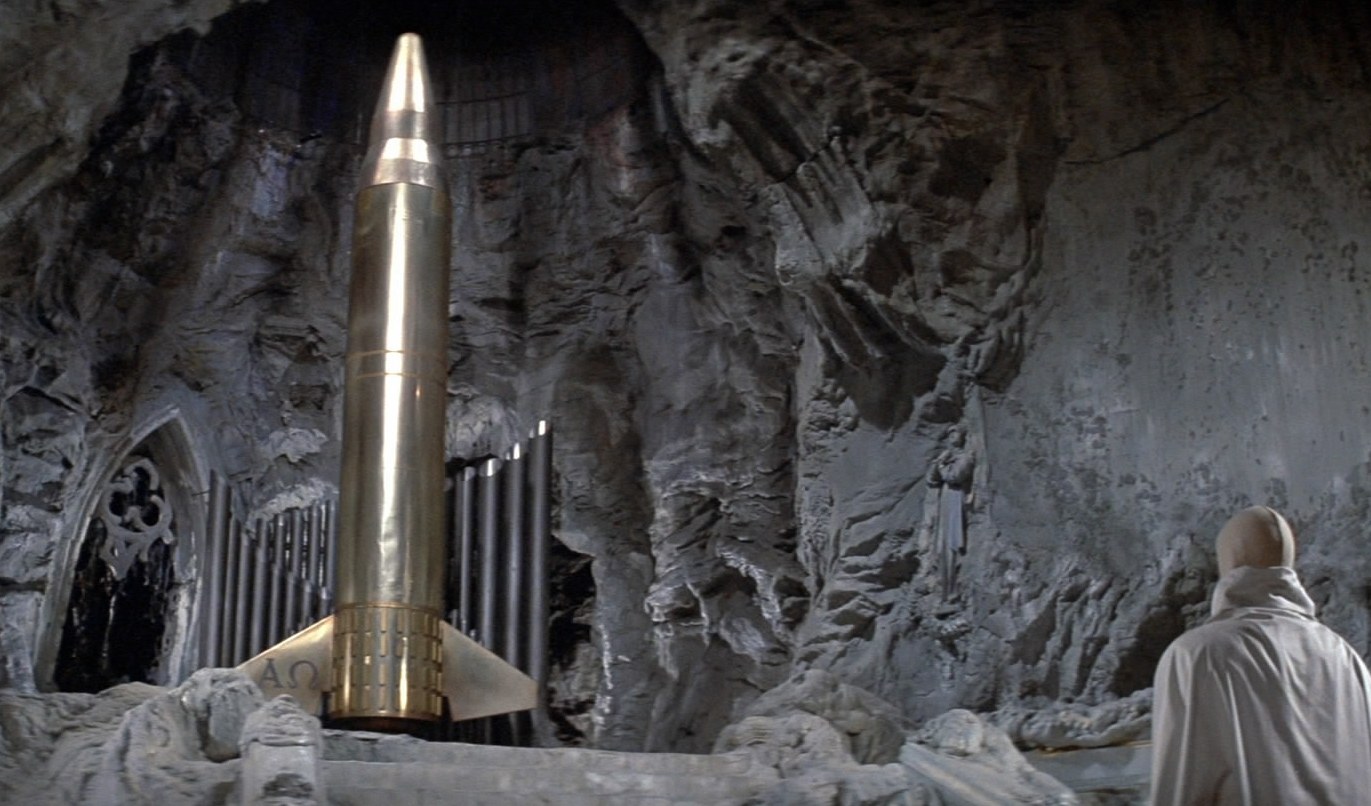
Object #34 - Alpha-Omega Bomb - Beneath the Planet of the Apes (1970)

Dir. Ted Post


Beneath the Planet of the Apes is quite possibly the weirdest sequel to a major film I've ever seen. The film is quite obviously done on less of a budget, with crowd scenes of the apes looking particularly shoddy due to poor mask work, as opposed to the stellar make-up/mask work on main ape characters. The lack of budget hangs over the film, and a lack of creativity permeates the first half of the film. Brent (James Franciscus) is on a search mission for first film protagonist, Taylor (Charlton Heston). Brent crashes his ship, discovers the mute human, Nova (Linda Harrison), discovers the ape civilization, meets kindly apes Zira (Kim Hunter) and Cornelius (David Watson), and discovers that human society has been destroyed by witnessing the remains of New York monuments - stop me if you've heard this one before. 

But it's from here on that the film becomes it's own, but oh boy is it weird! To step back a little, the film opens immediately after the iconic "You blew it up!" scene from Taylor. Taylor and Nova ride their horse further into the Forbidden Zone, which already feels odd as there's such a distinct feeling of 'Why am I watching this?', as in, why are we continuing a story directly after it's reached the twist climax? The message of the story is done, there's not much more to be done with Taylor as a character, nor the plot. To the film's credit, it realizes this and has Taylor fall into an invisible chasm in the rocks after witnessing a fiery wall. Then Brent's story re-hashes the original film's plot. 

Franciscus is a dead-ringer for Heston, and it really does feel like a poor-man's Planet of the Apes for around 50 minutes. But we've already seen Heston in new scenes! Why bother having the initial continuation? It's only there to explain how Taylor winds up in the city later in the film, and explain how Nova got away. This could so simply have been re-written! The scene with Nova meeting Brent, with Taylor's dog-tags tipping him off to Taylor's existence could have been kept, in fact, in would add a nice sense of mystery to Brent's proceedings. The only thing lost is the introduction of the fire-wall. It's really shoddy, and a very weird opening to the sequel of a majorly successful film.


After the re-hash, Brent and Nova discover a group of humans in the remains of New York city. They wear robes, appear emotionless, and can mind-control Brent and Nova to hurt each other. No you didn't miss anything, that's what happens! First of all, humans. In Planet of the Apes, particularly the ending scenes with the doll in the cave and of course, Lady Liberty herself, we are told that humans are long gone, long gone. An entire ape society has evolved since the nuclear war, and any humans left have devolved to lose their ability to speak, and act as the 'apes' of our time. Humanity, as we know it today, is gone. But here, it isn't. These humans, somehow, have survived the war, and have retained an air of civilization in this desolation. This undercuts the original film and the superb ending, as we know that just around the corner, in the Forbidden Zone, this group of civilized mutants were going about their business.

The humans have mutated to such a degree that they have psychic abilities, such as mind-reading and thought-control. If this sounds like a rip off of a Star Trek episode you're not far off, as the series was running at this time and has similar plots in some of it's episodes, such as Plato's Stepchildren, broadcast in late 1968, where all-powerful aliens control the minds of the Enterprise crew for their own entertainment. It really dives the up-until-know mature Twilight Zone/Star Trek vibe of the the series into the lower annals of those two shows, and is more of a direct rip off then ever, becoming kitschy and unrealistic. It is moderately unique however, as our object, the Alpha-Omega bomb, leads to some iconic and homageable scenes of their own.


The mutants worship an ancient nuclear bomb, with a congregation of worshipers who sing hymns to the tune of an organ, wear ceremonial robes, and in their moment of exaltation, remove their human masks to reveal their mutated, nuclear scarred faces. It's striking imagery, but not for all the right reasons. I normally hate criticizing a film for plot elements as it isn't the most important thing in my opinion, but here it's remarkable. So this is a nuclear wasteland, and yet these mutants have a working church, built into the rock, somehow have constructed masks to cover their mutations, and have also possess books, organs, and in later scenes, statuettes of their leaders. What?! Where did their find the materials for all this? Why would they bother creating the masks if they've no contact with other humans or apes? If they are descendants of human survivors of the war, then I doubt they even know what a regular human looks like, and if so, why would they care to look like them if all they've ever known is their mutated selves? If it's a religious thing, and they want to ascend back to the 'perfect' human, then why exalt in the mutation in the service? How did this religion even come to be? So many questions, some best left to the imagination to have some mystery and sense of prior story, but most need answering, as they detract from the plot and the world. 


And yet...that's sort of the point. It's so bold in the allegory it doesn't care to focus on the details. The themes and visuals are so strong that they become iconic. It's clearly a biting satire of the 'worship' of the nuclear bomb that won the Allies the Second World War, but also the 'worship' of it in 1950's American culture. It's no wonder that these mutants are referenced in the third game of the Fallout series, with the Church of the Children of Atom, as that series portrays a society that thrived using nuclear power, yet kept the 1950's values. The bomb, called the Alpha-Omega bomb, the beginning and the end, is the only way these mutants keep sane in this world, through worshiping the symbol of death and new-life. Their human lives were changed by the bomb, mutating their bodies yet enhancing their mental abilities, but crucially, not their intelligence. They believe they will become one with the world via the exploding of the bomb.

As this goes on, the apes invade the Forbidden Zone and storm the ruins and the church. It's downright surreal! Humanoid, intelligent apes with guns vs. mutant atomic-bomb worshiping humans, with Brent, Nova, and Taylor (two of which are out of time) caught in the middle. 


The bomb is damaged, and has enough energy to destroy the entire planet. In rapid succession, Nova is killed by the apes, Taylor is shot, and Brent gunned down after managing to shoot down the gorilla General Ursus (James Gregory). This is the end for these characters, who admittedly we've known for a short amount of time but it's shocking nonetheless in brutality. Taylor pleads with Dr. Zaius (Maurice Evans) for help stopping the bomb, but Zaius remains stuck in his ways, saying that man is only able to destroy. 

Taylor falls, gasping out "It's Doomsday" as he hits the detonation switch with his bloodied hand.
The bomb rumbles, we pan in on his hand, it slips, a white light fills the screen, then darkness. A voice-over tells us "In one of the countless billions of galaxies in the universe, lies a medium-sized star, and one of its satellites, a green and insignificant planet, is now dead". Then the credits roll, in silence. 


...WHAT? That's the ending, not only of this film, but to all the films in the series as they all take place chronologically behind Beneath. It's bold, bleak, and incredibly abrupt. In this surreal war-scape, main characters are removed brutally, they act not out of character, but out of character with the entire tone of the original film, and even the re-hash elements of this sequel. Would Taylor really want to exterminate this world after his extreme reaction to the ruins of Lady Liberty? Is this all Brent deserves, to be shot in this climactic battle for the entire fate of the world? But this battle doesn't feel that climactic, it isn't deserved by anything that comes before, it feels like a skirmish in the Forbidden Zone with some mutated freaks, which is exactly what it is. If it wasn't for this Alpha-Omega bomb which, incidentally, we are never informed how came to be, or be found, or survive the initial nuclear war, this would be a small, incidental battle.

The abrupt voice-over, the first use of it in the film, brings the matters of the world to a cosmic level, which jarrs with what we are seeing, and have seen throughout the film. This is how the Earth bites the bullet? Really? The beauty of the original film is that the climax of humanity happened in the past, leaving an interesting world behind. Seeing the event happen again in this way is not only unsatisfying, it's uncalled for, and with the voice-over we know there is no future at all this time. If this is the point the film is trying to make, that nuclear war would be the end of the Earth, then it squanders the fascinating allegory of the apes for no good reason. It's shocking, bold, unsatisfying, yet unshakable in the memory.